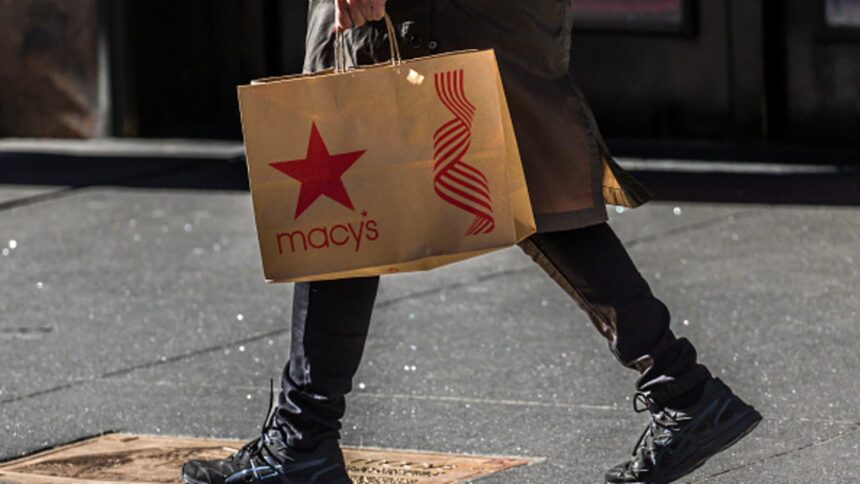
Macy’s has announced strong quarterly results that surpassed Wall Street’s expectations, demonstrating positive momentum for its flagship brand. In its latest fiscal report, the retailer revealed that its earnings per share reached $1.67, exceeding analysts’ predictions of $1.53. Revenue for the quarter amounted to $7.64 billion, slightly above the anticipated $7.62 billion. However, despite these wins, the company issued a cautious outlook for the fiscal year ahead.
For the upcoming fiscal year, Macy’s forecasts sales between $21.4 billion and $21.65 billion and adjusted earnings per share of $1.90 to $2.10. Both figures represent a decline from the prior fiscal year’s revenue of $21.8 billion and adjusted earnings of $2.15 per share. Analysts had projected a sales outlook of about $21.42 billion, but Macy’s earnings guidance fell short of the expected $2.17 per share.
Comparable sales, which exclude temporary variables such as new store openings, are projected to stay flat, with expectations of a 0.5% decline to a 0.5% increase. In comments to CNBC, CEO Tony Spring noted that the company’s strategies are showing results, with all three brands—Macy’s, Bloomingdale’s, and Bluemercury—recording growth during the fiscal year and holiday quarter. This marked the fourth consecutive quarter in which Macy’s outperformed sales targets and, for the first time in three years, the brand returned to positive growth, with a 1.5% increase in comparable sales for the full year.
Despite this positive trend, Spring cautioned about uncertainties in the retail landscape, which prompted a prudent outlook for Macy’s. “Given the environment that we operate in, it makes sense for us to not put a hockey stick out there and suggest that we have visibility into what the remainder of the year is going to reveal itself to be,” he explained, highlighting concerns over fluctuating gas prices, geopolitical tensions, and the potential impact of tariffs.
Macy’s guidance accounts for external economic and geopolitical influences anticipated to affect discretionary spending. Specifically, the company expects a more significant tariff impact in the first half of the fiscal year. However, Spring noted that Macy’s tariff expenses might decrease later this year as they compare against last year’s higher tariff rates. The company remains optimistic about potential refunds or lower future tariffs, stating that such developments would be beneficial.
For the fourth quarter, Macy’s net income increased to $507 million, or $1.84 per share, compared to $342 million, or $1.21 per share, the previous year. However, this was a slight decline in sales compared to $7.77 billion reported in the same quarter last year.
Macy’s has been undergoing a significant transformation over the past two years, focusing on revitalizing its core brand and enhancing its operations. Part of this strategy includes closing around 150 of its namesake stores by early 2027, with more than 80 closures already completed. Spring indicated the company is committed to selectively opening new Bloomingdale’s and Bluemercury locations, while he sees opportunities in reaching new markets.
In the fourth quarter, overall comparable sales increased by 1.8%. Notably, Macy’s own stores experienced only a modest 0.4% growth in comparable sales. Bloomingdale’s stood out with a remarkable 9.9% jump in comparable sales, while Bluemercury saw a 1.3% increase.
The holiday season proved successful across all three brands, reflecting effective merchandising and an engaging shopping experience that attracted both loyal and occasional customers. Spring reported that the resilient middle- and upper-end consumer segments remained active, purchasing fashionable goods rather than essentials.
As part of its turnaround efforts, Macy’s has taken steps to enhance the shopping experience in its remaining stores, with improvements in staffing and merchandise presentation. The company has invested in upgrading about 200 locations, which accounted for around 60% of the stores it intends to keep open, yielding positive sales results.
As of the latest trading session, Macy’s shares rose approximately 6% in premarket action, closing at $16.92, which boosted the company’s market value to about $4.5 billion. While the stock has increased nearly 25% over the past year, it has seen a decline of approximately 23% year to date.