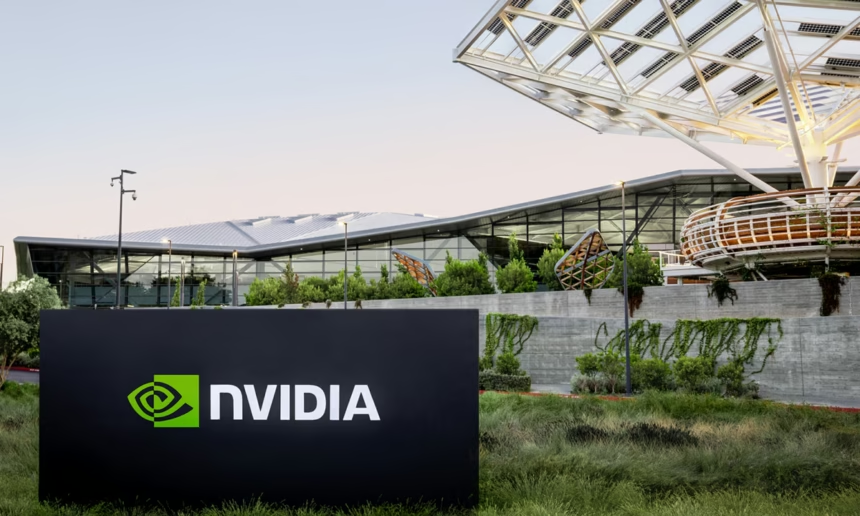
In a landmark achievement, Nvidia recently became the first company globally to reach a $5 trillion market capitalization. However, this milestone was swiftly followed by a dip in its stock performance, largely due to concerns about the sustainability of its significant investments in artificial intelligence (AI) infrastructure. Investors are also worried about potential geopolitical challenges that could impact the company’s operations.
While the broader PHLX Semiconductor Sector index has surged by 40% in the past six months, Nvidia’s stock has seen more modest gains of only 11%. Despite this, Nvidia’s stock has shown signs of recovery, soaring over 21% in April and reclaiming its $5 trillion market cap.
Analysts remain optimistic about the company’s future prospects, suggesting that Nvidia could become the first company to reach a $10 trillion valuation within the next three years. Central to Nvidia’s growth is its dominance in the AI inference market. For the past several years, Nvidia’s graphics processing units (GPUs) have been instrumental in training popular large language models (LLMs). Now, the company is positioning itself for success in the AI inference era, which focuses on applying trained AI models to new data.
Unlike the training phase, inference requires less computing power, making it economically attractive for hyperscalers and AI firms. Nvidia has been proactive in adapting to this shift. During a recent earnings call, CFO Colette Kress highlighted benchmarks from SemiAnalysis that declared Nvidia as the “inference king.” Recent models, such as the GB300 and NVL72, reportedly deliver up to 50 times the performance per watt and significantly lower costs compared to competitors.
The upcoming Vera Rubin processors are expected to further enhance Nvidia’s competitive edge by reducing inference costs by 90% compared to previous models. This development has led the company to anticipate a staggering $1 trillion in data center sales from both Blackwell and Vera Rubin products by 2026 and 2027, a major increase from an earlier forecast of $500 billion.
Nvidia is not just a player in AI inference; it is also heavily involved in physical AI applications, generating $6 billion in revenue in 2025 from sectors like automated factory robots and robotaxis. With a projected market growth to $3.25 trillion over the next 15 years, Nvidia’s partnerships with companies such as Anthropic, Meta Platforms, xAI, and OpenAI place it at the forefront of innovation in the AI application landscape.
Overall, Nvidia appears well-positioned for long-term growth, and analysts indicate that the company could achieve a $10 trillion market cap sooner than expected. Currently trading at 42.5 times earnings, Nvidia’s valuation is higher than that of the Nasdaq-100 index, which stands at 33.4 times. However, this premium is viewed as justified when considering Nvidia’s robust earnings growth potential.
The company’s earnings per share is projected to increase by 75% this fiscal year, reaching $8.34. In contrast, the tech sector’s average earnings growth is expected to be around 44% year-over-year. Looking ahead, if Nvidia achieves earnings of $13.60 per share by fiscal year 2029 and maintains a valuation aligned with the Nasdaq-100’s average, its stock could potentially trade at over $449—more than double its current price.
With the substantial ongoing investments in AI data centers, many believe that Nvidia still has ample room for growth, making it an appealing option for investors looking to capitalize on the booming AI market.