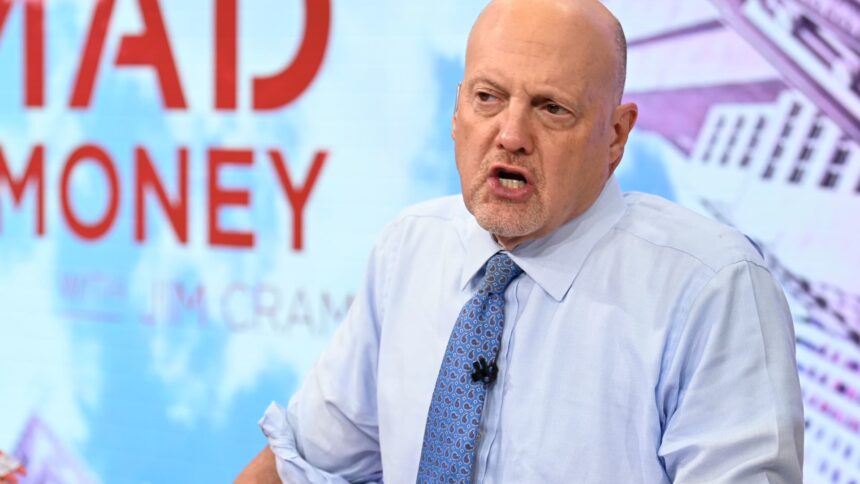
Oil prices surged alongside concerning inflation data, causing market turbulence on Wednesday and presenting investors with limited options. CNBC’s Jim Cramer provided insight on “Mad Money,” suggesting that despite the challenging environment, select stocks remain worth considering. He specifically recommended Nvidia, an AI leader and a favored pick among CNBC Investing Club members. Cramer emphasized that Nvidia’s current struggles are more a result of market dynamics rather than external geopolitical issues like the ongoing Iran conflict or concerns about stagflation. He noted that the high ownership levels of Nvidia’s stock may be contributing to its sluggish performance.
Over the past several months, Nvidia’s stock has experienced a lack of significant movement despite its strong earnings reports and positive developments. Cramer hinted that the company’s prospects could change in the wake of announcements made during this week’s GTC developers event. Among these announcements were details about a new inference chip and projections for $1 trillion in orders related to Blackwell and Vera Rubin through 2027. After attending the event, Cramer interviewed Nvidia CEO Jensen Huang, who expressed enthusiasm about the company’s future, including predictions surrounding OpenClaw, which he described as a potential successor to ChatGPT.
Cramer characterized Nvidia’s valuation as relatively low compared to its growth potential, advising investors to consider purchasing some shares—though he cautioned against going all in due to the broader economic uncertainties. Analysts from Cantor Fitzgerald have forecasted Nvidia’s earnings per share to reach $15 by 2027, which would place its stock at roughly 12 times those earnings, compared to an 18 times multiple for the S&P 500.
The broader market faced significant declines, with the Dow Jones Industrial Average closing at its lowest level since 2026, dropping over 750 points, or 1.6%. This downturn was largely attributed to rising oil prices and alarming inflation figures from February prior to the U.S. and Israel’s military actions against Iran. The S&P 500 declined by 1.36%, while the Nasdaq dropped by 1.46%.
Federal Reserve Chairman Jerome Powell’s remarks later in the day failed to instill confidence in the markets. He acknowledged that inflation was not decreasing as much as expected. Nonetheless, Powell alleviated concerns about stagflation, stating that unemployment figures do not mirror the dire conditions of the 1970s.
Despite these headwinds, Cramer reiterated the challenge of identifying promising investments in the current economic climate, returning to his bullish stance on Nvidia. He described the company’s exceptional growth paired with attractive valuations as an “irresistible combination.” However, he also indicated that external pressures, such as high oil prices and a potentially cautious Federal Reserve under new leadership, could pose short-term challenges for Nvidia’s stock.
Cramer concluded by affirming that such fluctuations are less relevant to Nvidia’s long-term outlook, maintaining confidence in its future in the AI space.