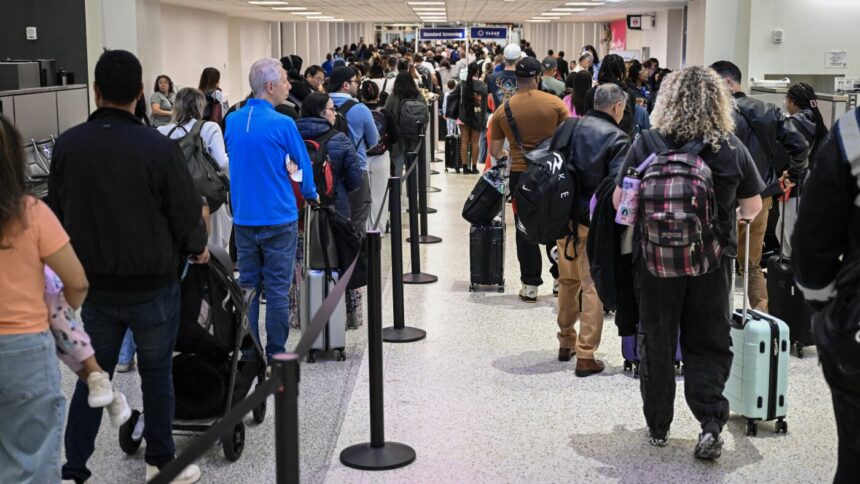
As spring break unfolds across the U.S., travelers are confronting significant delays at major airports due to a shutdown of the Department of Homeland Security (DHS). This situation has forced Transportation Security Administration (TSA) screeners to work without pay, exacerbating long wait times. Congressional Democrats have refused to allocate funding to the agency, hoping to leverage the situation for reforms in federal immigration enforcement practices.
Reports indicate that wait times at notable airports in Houston and Atlanta reached up to two hours. New Orleans’s Louis Armstrong International Airport has advised travelers to arrive at least three hours before their flights. In Philadelphia, officials closed three security checkpoints due to a lack of staffing, compounding the frustrations for passengers.
President Trump has threatened to dispatch Immigration and Customs Enforcement (ICE) agents to airport security lanes should Democrats fail to approve funding for the DHS. He expressed this intention through a series of posts on social media, suggesting that ICE agents could manage security in a way that includes the apprehension of undocumented immigrants at airports. This declaration came amid ongoing negotiations between a bipartisan group of senators and the White House aimed at resolving the deadlock.
The long wait times are attributed to a significant staffing shortage within the TSA, as approximately 50,000 TSA employees have been working without pay since the government shutdown began on February 14. A recent analysis revealed that more than 300 TSA officers have resigned, with extensive call-outs reported in major cities. In Houston, for example, more than half of the TSA staff called in sick last week, leading to systemic delays.
Transportation Secretary Sean Duffy warned that the situation could deteriorate further. He noted that a second missed paycheck for TSA employees could severely impact their morale and willingness to work. He also mentioned that if the staffing shortages persist, smaller airports may even face temporary closures.
The impact of these delays is not confined to domestic travelers; the U.K. Foreign Office has echoed concerns, advising travelers to anticipate disruption at U.S. airports. Amid this chaos, billionaire Elon Musk proposed a controversial solution, offering to cover the salaries of TSA personnel during the funding standoff. However, U.S. law generally prohibits government employees from receiving outside compensation.
Despite the challenging travel environment, Americans continue to show a strong desire to fly, influenced by a projected 171 million total passengers traveling on U.S. airlines during March and April. This travel surge occurs simultaneously with increases in global oil prices due to the war in Iran, prompting United Airlines to announce flight cuts over the following six months as jet fuel costs have skyrocketed.
Travel experts caution that the uncertainty surrounding travel conditions is as critical to consider as the long wait times. They recommend that travelers check airport websites for real-time security wait times and prepare for unexpected changes in airport operations. Smaller airports operating under private contractors, bypassing TSA staffing shortages, have emerged as more reliable options.
Those planning to travel are advised to allocate ample time for airport arrival and consider enrolling in expedited screening programs like TSA PreCheck or the private CLEAR service, which can facilitate faster access through security. Travelers are encouraged to install airline apps on their mobile devices to streamline booking and rebooking processes in the event of delays or cancellations.
In conclusion, while the appetite for travel remains unshaken, the current environment poses various challenges, requiring travelers to stay informed and adaptable in the face of ongoing disruptions.