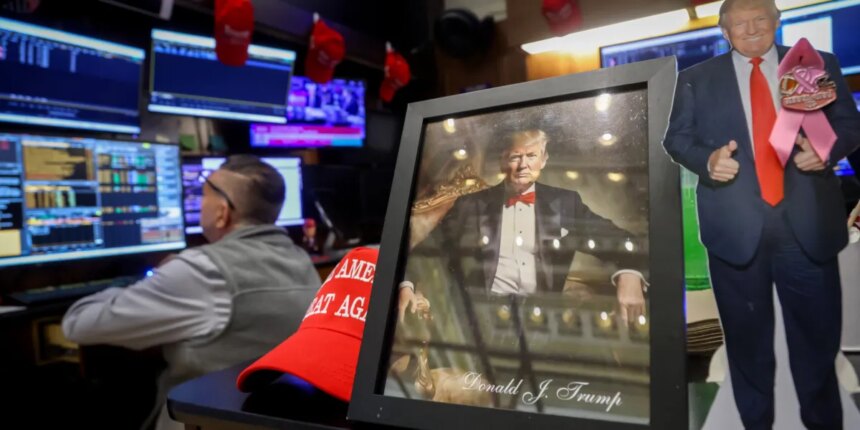
In recent weeks, financial markets have experienced unprecedented volatility, largely attributed to the erratic statements and actions of former President Donald Trump. His influence continues to dominate market dynamics, showcasing the significant impact one individual can have on global finance. This was starkly evident when Trump’s comments about a potential ceasefire in the conflict with Iran led to a substantial market surge of 6%. Conversely, similar declarations made a year ago resulted in a sharp decline of 20%.
The ongoing tensions with Iran have birthed a new market era that some are dubbing the “Trump Market.” Within this environment, investors have found themselves at the mercy of Trump’s whimsical pronouncements, often conveyed through his Truth Social platform. Such communications have incited market fluctuations that can rise or fall by as much as 15% in a single day, mirroring the levels of chaos seen during the COVID-19 pandemic.
A growing consensus among investors suggests that understanding Trump’s mindset has become more vital than comprehending traditional macroeconomic indicators like interest rates or inflation data. His perceived whims and strategic reversals offer clues that are critical for navigating today’s unpredictable financial landscape.
Three key lessons emerge from a newly released book, “Trump’s Ten Commandments,” which seeks to uncover the thought patterns that guide Trump’s decisions.
The first lesson emphasizes that for Trump, the stock market serves as a crucial gauge of his leadership effectiveness. Markets are his primary feedback mechanism, influencing his decisions more than any external commentary from his critics or allies. Investors have noted the recurring behavior where Trump retracts controversial statements when markets react negatively, only to revert to original stances once market calm resumes. This cycle of escalation and retreat underscores his prioritization of financial markets as a key constraint.
The second lesson posits that Trump’s inconsistencies are deliberate strategies rather than signs of weakness. His pragmatic approach allows him to flip alignments and messages as needed, keeping options open to maximize his leverage. This results in fluctuating narratives—from promoting a quick end to conflict one day to intensifying military threats the next. Such unpredictability not only safeguards his political positioning but also influences public sentiment and market stability.
Lastly, the book asserts that Trump’s negotiating style leans heavily on aggression, as opposed to traditional trust-building methods. Rather than offering compromises, he often escalates conflicts to extract maximum concessions. The anticipated arrival of additional U.S. military forces in the Middle East may embolden him to pursue even bolder moves, further complicating the already tense geopolitical landscape.
In conclusion, as investors adapt to the shifting terrain influenced by Trump’s actions, the underlying patterns of his decision-making may provide essential insights into upcoming market movements. The political and economic implications of his strategies will likely continue to unfold, leaving financial markets in a state of flux.