Bitcoin’s recent downturn has intensified, declining by an additional 2% within a 24-hour period and falling below the $68,000 mark for the first time in four days. This drop triggered substantial liquidations, exceeding $50 million in the past hour alone, according to data from Coinglass. Notably, approximately 70% of these liquidation events were tied exclusively to Bitcoin positions.
The repercussions of Bitcoin’s decline echoed across the cryptocurrency market, adversely impacting shares of related companies. Firms such as Circle Internet (CRCL), Coinbase (COIN), and MicroStrategy (MSTR), which is recognized as the largest public holder of Bitcoin, experienced declines during pre-market trading.
In trading terminology, liquidations occur when exchanges forcibly close leveraged positions due to insufficient collateral, known as margin, held by the trader. Current analysis of a 48-hour liquidation heatmap points to considerable liquidity levels below $66,000, suggesting that further downturns for Bitcoin could materialize in the near term.
Adding to the negative sentiment surrounding the cryptocurrency market is the indicator of funding rates, which currently reflect a bearish outlook. These rates facilitate periodic payments between traders engaging in perpetual futures contracts—a type of derivative that tracks asset prices without an expiration date. When funding rates are negative, it indicates that traders betting on price declines (short traders) are compensating those anticipating price increases (long traders).
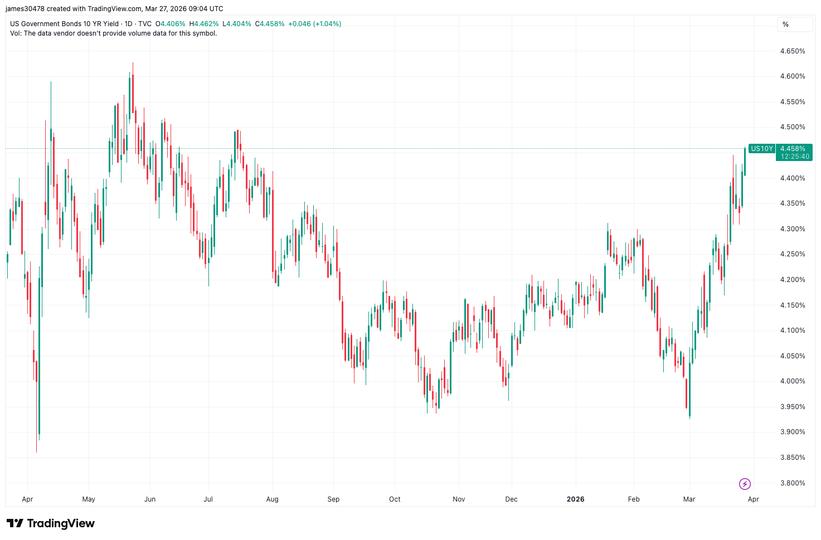
Macroeconomic conditions are also deteriorating, significantly impacting the risk appetite for assets like cryptocurrency. The 10-year U.S. Treasury yield, a critical benchmark for government borrowing costs, is nearing 4.5%, marking its highest rate since July. This increase renders riskier assets, such as cryptocurrencies, less appealing. Furthermore, the MOVE index, which gauges volatility in the U.S. bond market, has surged by 18% over the last day, highlighting growing market uncertainty.
Concurrently, oil prices have risen by 3%, driven by disruptions in Russian oil supplies attributed to the Ukraine conflict, complicating efforts to stabilize global energy supplies. In this volatile environment, the DXY index, which measures the dollar’s strength against a basket of major currencies, is ascending towards the 100 mark, presenting additional challenges for risk assets.
In summary, the combination of Bitcoin’s decline, rising interest rates, increased market volatility, and unfavorable funding rates signals a challenging period ahead for the cryptocurrency sector and other associated markets.