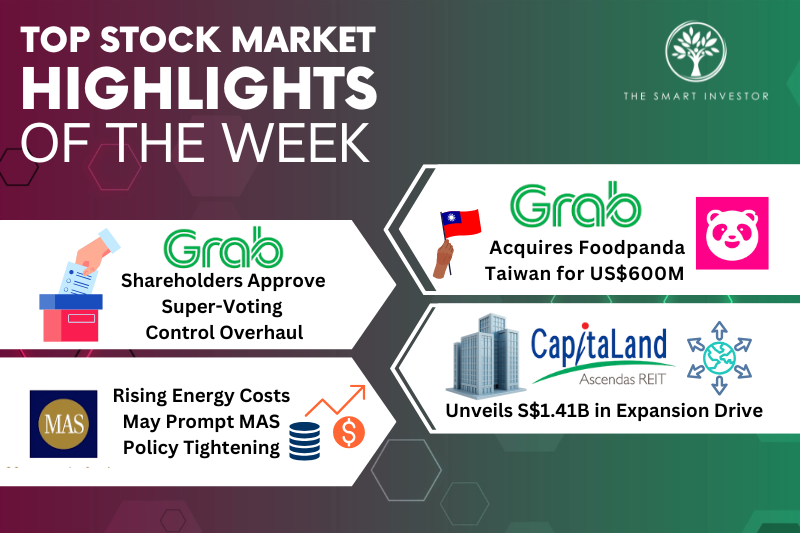
This week’s developments in the Singapore market spotlight a blend of significant corporate maneuvers amid a tightening economic climate, marked by surging energy prices. Notably, Grab Holdings Limited has made headlines with its groundbreaking US$600 million acquisition of foodpanda Taiwan, which is a pivotal move in their expansion strategy beyond Southeast Asia. This acquisition is expected to close in the latter half of 2026, with a full transition of users and merchants slated for early 2027. This initiative positions Taiwan as Grab’s ninth market, enhancing its reach to 21 cities and leaving Uber Eats as its main competitor in this market of 23 million residents. Foodpanda’s existing operations in Taiwan have reported profitability on an adjusted EBITDA basis, with a projected contribution from the deal of at least US$60 million by 2028.
Grab aims to leverage its proprietary AI-driven tools to bolster growth, including the implementation of GrabMaps for efficient route optimization and an AI merchant assistant. CEO Anthony Tan expressed optimism regarding Taiwan’s logistics landscape, which aligns well with Grab’s operational strengths.
In a move that significantly consolidates power within the company, Grab’s shareholders approved at an extraordinary general meeting a resolution that doubles the voting power of Class B ordinary shares from 45 to 90 votes each. This change grants CEO Anthony Tan a definitive two-thirds majority in voting, increasing his power from 59.9% to approximately 74.9%. This governance overhaul has raised concerns among observers about the dilution of influence for Class A shareholders, despite not impacting their economic stake. The modification aims to maintain a long-term strategic focus for Grab and ensure compliance with regulatory requirements from the Monetary Authority of Singapore (MAS).
In parallel, CapitaLand Ascendas REIT (CLAR) has announced an aggressive S$1.41 billion expansion strategy targeting data centers and logistics across Singapore and Japan. This expansion is anticipated to be DPU-accretive, projecting a pro forma uplift of around S$0.0318 or 2.1%. Specific acquisitions include the ramp-up logistics complex at 25 Loyang Crescent for S$504.2 million and a 50% stake in Ascent at Science Park Drive for S$245 million. The most substantial transaction involves a S$620.7 million investment for a 49% stake in a Tier III hyperscale data center in Osaka, Japan, which is fully leased with a robust 14.2-year weighted average lease expiry.
CapitaLand’s CEO William Tay pointed out that this move into Japan’s data center market is strategic, tapping into a sector projected to grow 24% annually through 2030, fueled by the demand for AI technologies. While Singapore remains the core of CLAR’s S$19.9 billion portfolio, this expansion diversifies its international presence in high-growth digital infrastructure.
However, these impressive corporate developments occur against a backdrop of shifting inflation expectations in Singapore, largely influenced by increasing energy costs linked to unrest in the Middle East. Economists from prominent financial institutions now predict that the MAS will likely tighten monetary policy during its April review, with February’s headline inflation easing slightly to 1.2%, but core inflation reaching a 14-month peak of 1.4%. Rising costs related to imports indicate potential upward pressure on inflation, prompting analysts to adjust forecasts accordingly.
As consumers grapple with higher prices for electricity, fuel, and food, the Singapore dollar nominal effective exchange rate (S$NEER) has been trading close to the upper limits of its policy band. Consequently, financial analysts are anticipating a possible 50-basis-point increase in the policy slope in April to counteract these inflationary risks.
A new S$5 billion market boost from the government may also provide fresh capital into local stocks, with several companies identified as likely beneficiaries of this initiative. The ongoing developments reveal a landscape characterized by both ambitious corporate growth and significant economic pressures that could reshape Singapore’s financial environment in the months to come.