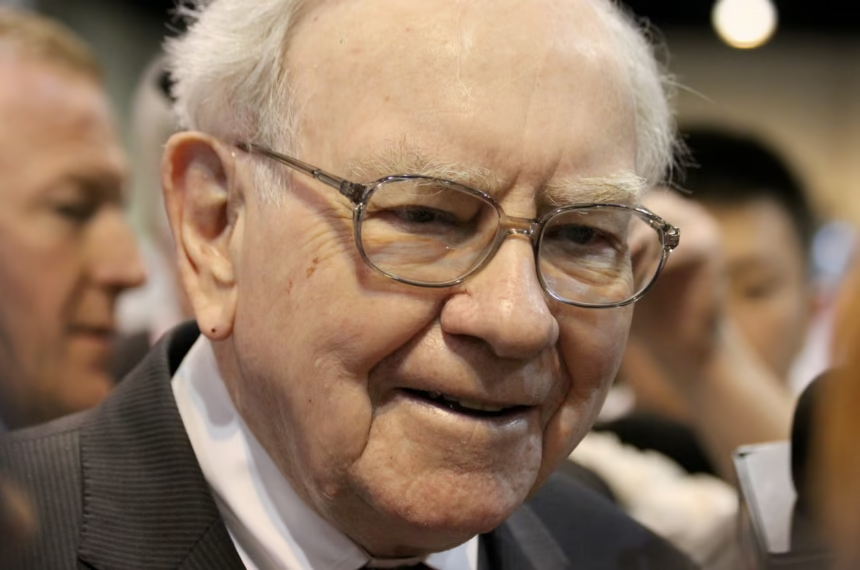
Warren Buffett, the iconic investor who led Berkshire Hathaway for several decades, revolutionized investment strategies with his philosophy prioritizing quality over price. Buffett famously stated that it is “far better to buy a wonderful company at a fair price than a fair company at a wonderful price.” This approach underpinned his investing strategy during his tenure as CEO, which initiated in 1965 and is set to conclude at the end of 2025. Even after his retirement, his longtime colleague, Greg Abel, who has taken over as CEO, has expressed intentions to maintain the company’s operational structure and key investments without immediate changes.
Among Berkshire Hathaway’s extensive portfolio, certain stocks stand out as prime candidates for acquisition and retention in various market conditions. These prominent holdings include tech giant Apple, financial service provider American Express, and beverage leader Coca-Cola.
Berkshire’s investment in Apple is particularly noteworthy. With a 1.6% stake valued at around $56.4 billion, Apple represents approximately 18.1% of Berkshire’s entire portfolio, making it the company’s largest equity position. Historically, Buffett was cautious about investing in technology stocks due to the volatile nature of the industry. However, Apple captured Buffett’s attention due to its robust customer loyalty and the formidable ecosystem it has built, which makes consumer transitions to competitors challenging. Currently trading at 32 times forward earnings estimates, Apple may be perceived as carrying a fair price given the ongoing enthusiasm for artificial intelligence stock investments. Nonetheless, its consistent earnings growth, share repurchase commitments, and a growing dividend yield of 0.4% suggest strong potential for total returns over the long term.
American Express mirrors this investment strategy, showcasing similar resiliency and brand loyalty. Berkshire Hathaway accumulated a 22% stake in American Express between 1991 and 1995. Over the years, American Express has consistently outperformed the S&P 500, making it a cornerstone investment. Despite recent market trends favoring the S&P 500, American Express is well-positioned for the future, particularly due to the sustained demand from affluent and younger consumers. The stock currently has forward earnings estimated at 19 times, which aligns with its historical valuation range. While the dividend yield stands at approximately 1.3%, the company has a track record of double-digit annual growth rates in dividends, enhancing its appeal for long-term investors.
Coca-Cola remains one of Berkshire Hathaway’s longest-held investments. The conglomerate owns 9.3% of Coca-Cola, reflecting about 9.7% of its portfolio. Since entering the Coca-Cola market in the late 1980s through extensive buying, the beverage company has delivered total returns that closely track the S&P 500. However, Coca-Cola has been a steady provider of returns, largely thanks to its unwavering commitment to dividend growth. The company’s stock has seen a total return of 3,580% since Berkshire’s initial investment, slightly below the S&P 500’s 3,700%. Coca-Cola’s impressive record of 64 consecutive years of annual dividend increases, with an average growth rate of 4.5% over the past ten years, underscores its position as a reliable income generator for Berkshire, which utilizes dividend income to fund new investments.
In summary, even after Buffett’s departure, Berkshire Hathaway is poised to retain and potentially grow its core investment portfolio, centered around companies like Apple, American Express, and Coca-Cola, all of which exhibit strong fundamentals and long-term growth potential.