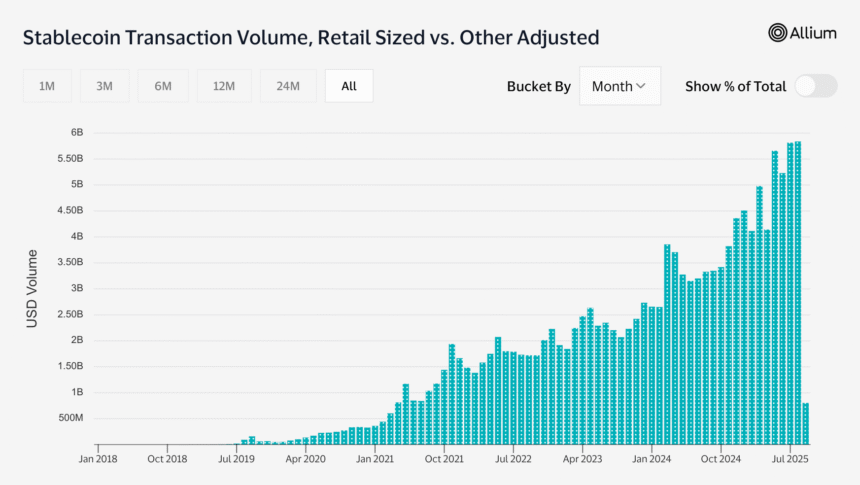
Stablecoin adoption among retail users has reached unprecedented levels this year, according to a report from CEX.io, with transaction volumes through August already surpassing the total for all of last year. In what has been described as a significant milestone, retail-sized transfers—defined as transactions under $250—exceeded $5.84 billion in August alone, marking the highest monthly figure ever recorded. With nearly four months remaining in the year, 2025 is on track to become the busiest period yet for stablecoin transfer volumes at the consumer level.
The report highlights the increasing integration of stablecoins—cryptocurrencies pegged to fiat currencies, such as the U.S. dollar—into everyday financial activities. They are being employed for a range of purposes, including cross-border remittances and microtransactions. Support for this trend comes from survey data gathered from over 2,600 consumers in emerging markets, including Nigeria, India, Bangladesh, Pakistan, and Indonesia. The findings indicated that a substantial majority of respondents chose stablecoins as a means to avoid exorbitant banking fees and delays in transfers. Approximately 70% reported using stablecoins more frequently than they did in the previous year, and more than three-quarters expressed optimism that their usage would continue to grow.
The report also noted an interesting shift in blockchain activity distribution. Traditionally, the Tron blockchain has been favored for retail transfers, particularly due to its low fees and extensive support for Tether’s USDT. However, it has recently lost market share, experiencing a decline of 1.3 million monthly transactions, or 6%, with volume growth failing to keep pace with its competitors.
In stark contrast, Binance Smart Chain (BSC) has emerged as the preferred choice among retail users, capturing nearly 40% of the stablecoin market. Its transaction counts surged by 75% this year, and transfer volume increased by 67%. A key factor in this momentum was Binance’s decision to delist USDT for European users in March, combined with a resurgence of memecoin trading on PancakeSwap, a platform operating on BSC.
The Ethereum network, encompassing both the base layer and its layer-2 solutions, accounted for over 20% of transfer volumes and 31% of transaction counts. While the mainnet has traditionally been utilized for larger transactions—attributed to higher fees—recent trends indicate a considerable uptick in retail usage. Sub-$250 transfers on Ethereum’s mainnet increased remarkably, with a rise of 81% in volume and 184% in transaction counts. The substantial drop in transaction costs, which have decreased by more than 70% over the past year, has rendered Ethereum mainnet transactions far more appealing, even for smaller amounts.
In summary, the growing reliance on stablecoins by retail users illustrates a fundamental shift in how consumers approach financial transactions, particularly in regions where traditional banking options may be limited or costly. As blockchain technology continues to evolve, so too does the landscape of digital finance, with stablecoins at the forefront of this transformation.