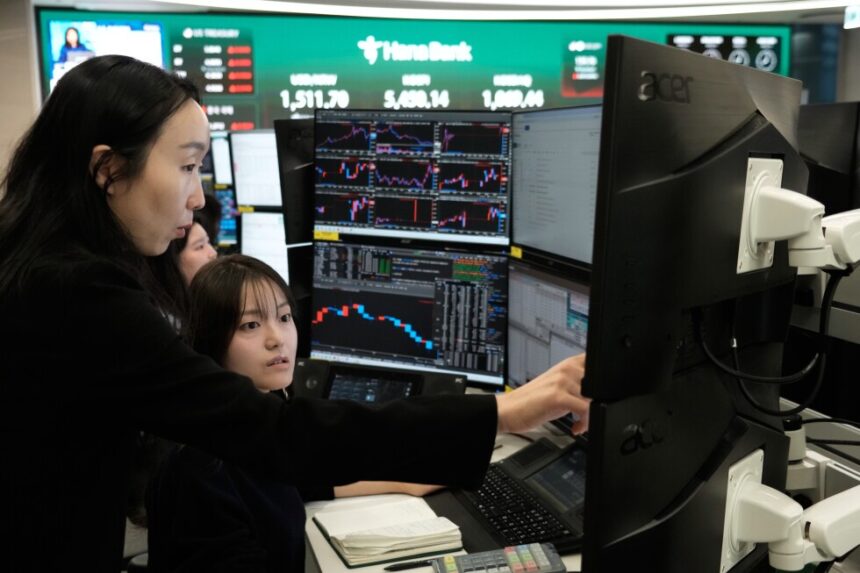
Asian markets displayed a positive trend on Monday, with investors remaining vigilant amid escalating tensions stemming from the ongoing conflict in Iran, rising oil prices, and anticipating statements from President Donald Trump. Japan’s benchmark Nikkei 225 saw a significant increase, climbing nearly 1.1% to reach 53,692.42 during morning trading sessions. Similarly, South Korea’s Kospi recorded a gain of 1.5%, closing at 5,460.24. In contrast, markets in Australia were closed for Easter, while trading in Hong Kong and Shanghai was halted due to a traditional Chinese holiday.
The situation in Iran is particularly pressing, as the Tuesday deadline set by Trump for Iran to reopen the strategically significant Strait of Hormuz approaches. Analysts express concerns that hostilities may escalate following this deadline. President Trump has issued further threats against Iran over the weekend, coinciding with ongoing military actions in the region. Significantly, the United States successfully rescued two aviators whose fighter jet was downed by Iranian forces, further complicating the geopolitical landscape.
One focal point for investors remains the fluctuations in oil prices. Benchmark U.S. crude rose by 38 cents, settling at $111.92 a barrel, while Brent crude, regarded as the international standard, increased by $1.71 to $110.74 a barrel. Although energy markets were closed on Friday, the recent increases in oil prices are largely attributed to fears of a protracted conflict in Iran affecting supply dynamics.
While the United States is not heavily dependent on oil imports from the Persian Gulf, the global nature of oil pricing means shifts in supply can have widespread impacts. Countries with limited natural resources, such as Japan, find themselves particularly vulnerable to fluctuations in energy prices, given their reliance on the Strait of Hormuz for energy imports.
“As we kick off the first full trading week of April, the word uncertainty is paramount. Last year it was centered on the impact of ‘Liberation Day’ tariffs, this year it’s uncertainty surrounding the ongoing Iranian War,” noted Jay Woods, analyst at Freedom Capital Markets in New York.
In overseas trading, U.S. markets were closed for Good Friday and are set to reopen on Monday. Several European markets also remained inactive on Friday. In currency trading, the U.S. dollar slightly strengthened, reaching 159.65 Japanese yen on Monday, up from 159.63, while the euro dipped to $1.1509, a decrease from $1.1517.