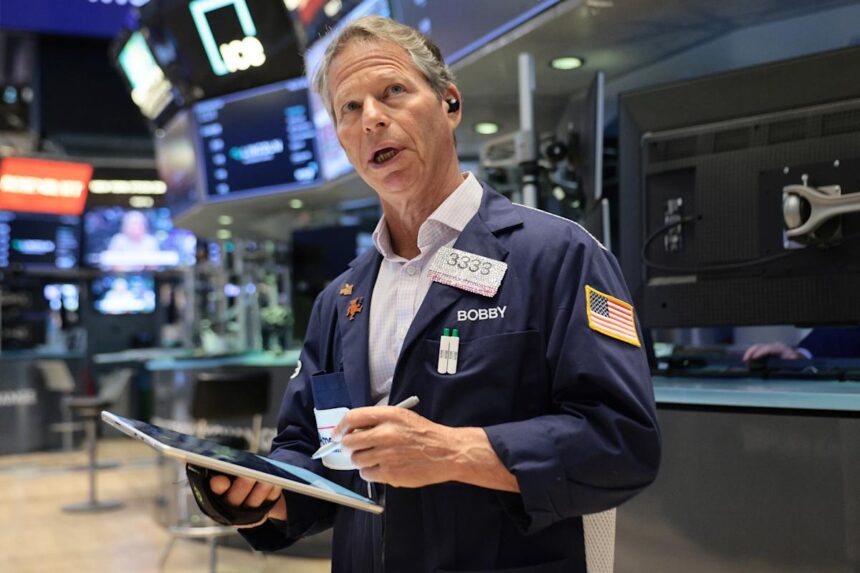
U.S. stocks experienced a downturn on Thursday, driven by renewed tensions surrounding negotiations with Iran. Following a directive from Iran’s Supreme Leader, stating that the country’s near-weapons-grade uranium should not be exported, concerns grew regarding the possibility of a peace deal between the U.S. and Iran. This news led to a decline in major market indices, with the Dow Jones Industrial Average and the benchmark S&P 500 both falling 0.4%. The tech-heavy Nasdaq Composite saw a slightly larger decrease of 0.5%.
In the commodity market, oil prices surged. Brent crude oil prices rose above $108 per barrel, while U.S. West Texas Intermediate (WTI) crude climbed back over $100 amid the ongoing stalemate in negotiations between the U.S. and Iran. President Trump had suggested earlier in the week that a resolution might be forthcoming, expressing his willingness to wait for Iran to consider the latest U.S. peace proposal. However, the Supreme Leader’s recent comments cast doubt on any potential advancements in discussions.
Investor sentiment was also influenced by Nvidia’s latest earnings report, which exceeded both revenue and profit forecasts but left some investors wanting stronger indications of demand in the chip market. Following Nvidia’s announcement, SpaceX made headlines by filing an S-1 registration statement with the Securities and Exchange Commission, offering a rare insight into the company’s financials ahead of its upcoming IPO.
As earnings season progresses, notable retailers reported their results: Walmart surpassed expectations for both revenue and earnings per share, while investors eagerly awaited reports from Ross Stores, Workday, and Zoom Communications later that day.
In labor market news, initial jobless claims rose to 209,000 for the week ending May 16, which was slightly below economists’ predictions of 210,000. The previous week’s claims had been revised upward from 212,000. The four-week moving average decreased to 202,500, and continuing claims rose marginally to approximately 1.782 million.
In bond markets, yields continued to climb, suggesting that investors are signaling to the Federal Reserve that current interest rates may not be adequate. The 2-year Treasury yield reached 4.1%, surpassing the Fed’s target range, while the 10-year Treasury yield nearly touched 4.7%. Ed Yardeni remarked that the rise in yields could pressure the Fed to tighten credit conditions to maintain economic stability amidst rising inflation.
Additionally, in the automotive sector, Stellantis announced a strategic turnaround plan aimed at enhancing its core brands—Jeep, Ram, Peugeot, and Fiat—while reducing focus on Chrysler and Dodge. The company projected that this restructuring could yield returns as high as 10% in North America by 2030, supported by a planned investment of approximately $70 billion, a significant portion of which will be allocated to its prioritized brands.
In the realm of technology, a report indicated that the U.S. is poised to grant $2 billion in awards to various quantum computing companies as part of a deal that would involve equity stakes in exchange for funding. Notably, IBM is set to receive a substantial portion of this financial package. This news sparked a surge in the stock prices of several quantum computing companies in premarket trading, reflecting heightened investor interest in this emerging sector.
Overall, the anxieties stemming from geopolitical tensions, along with fluctuating corporate earnings, shaped a day of losses for U.S. markets, with investors navigating a complex landscape of economic indicators.