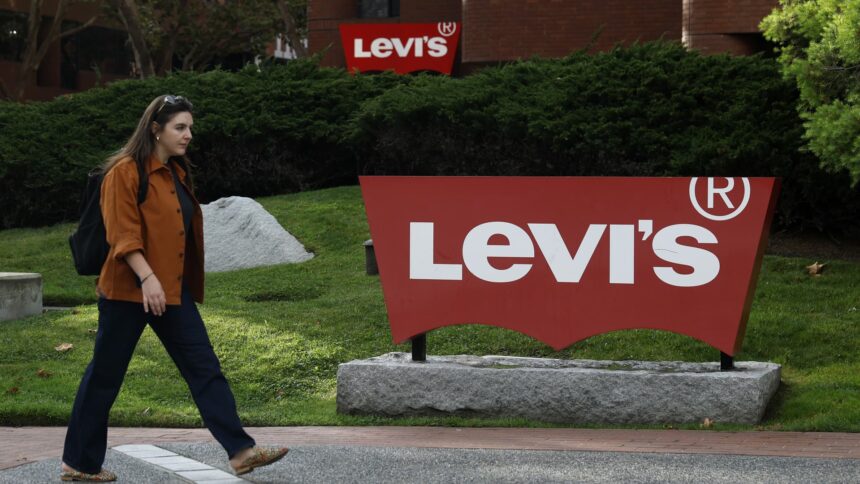
Levi Strauss recently reported robust sales performance, driven in part by increased prices and a significant shift towards direct-to-consumer (DTC) sales, which now account for more than half of the company’s total revenue. This marks a pivotal moment for a brand that has traditionally depended on wholesalers for its sales.
In the latest financial quarter, Levi’s revenue surged by 14%, reaching $1.74 billion, compared to $1.53 billion during the same period last year. DTC sales, encompassing transactions through Levi’s own stores and website, rose by an impressive 16%, accounting for 52% of overall revenue. CEO Michelle Gass expressed optimism in an interview with CNBC, projecting that DTC revenue will continue to comprise more than half of total sales for the remainder of the year, despite ongoing growth in the traditional wholesale sector.
Notably, the company’s financial chief, Harmit Singh, who announced plans to retire, cited that half of Levi’s growth is tied to recent price increases, while the other half is attributed to actual units sold. This strategic focus on DTC not only allows for higher margins but also presents initial challenges as the company reshapes its distribution system, slightly impacting earnings.
As a result of its solid quarterly performance, Levi has adjusted its financial guidance. The company anticipates full-year adjusted earnings per share to fall between $1.42 and $1.48, slightly below market expectations of $1.47 on the low end, as reported by LSEG. Sales are projected to increase by 5.5% to 6.5%, surpassing estimates of 5.6%.
Breaking down the quarterly performance against Wall Street estimates reveals the following outcomes: earnings per share came in at 42 cents adjusted, above the anticipated 37 cents, and revenue reached $1.74 billion, significantly higher than the expected $1.65 billion. The reported net income for the period ending March 1 was $175.8 million, or 45 cents per share, compared to $135 million, or 34 cents per share, in the previous year.
Levi’s commitment to a DTC-led approach is proving beneficial, even with accompanying short-term costs related to distribution changes. Singh noted that as DTC sales expand, profitability is expected to improve. Moreover, the company is currently operating under the assumption of a 20% global tariff, but with the potential for changes in U.S. trade policy that could result in a lower 10% tariff, this could enhance earnings projections by around $35 million.
While optimism remains about DTC growth, there are rising concerns about potential consumer spending slowdowns amid escalating gas prices, which might deter purchases of non-essential clothing items. However, Gass indicated that no downturn in spending has been observed thus far, crediting the company’s broad segmentation approach that appeals to various consumer demographics. Sales from Levi’s value brand Signature rose by 16%, and the middle-market Red Cap increased by 9%, while the premium Blue Tab line is also experiencing growth.
Gass emphasized the importance of strategizing around the Levi’s brand umbrella, following significant changes in the company structure, including the sale of Dockers and other divisions. With approximately 60% of its business originating outside the U.S., Levi anticipates that this geographical diversification will provide additional stability moving forward. The company remains vigilant about market dynamics but feels confident about its prospects in the current consumer landscape.