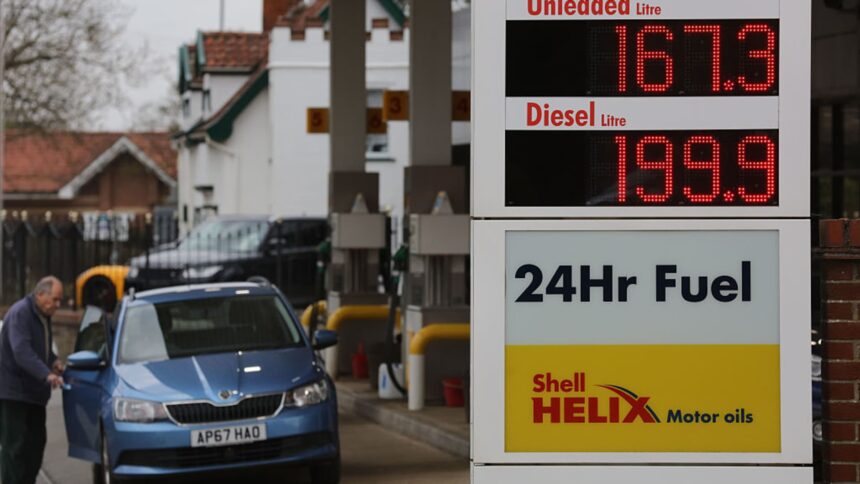
Prices for diesel in Long Stratton, England, are nearing £2.00 a litre as inflation in the U.K. surged to 3.3% in March, primarily driven by rising fuel costs amid the ongoing conflict in Iran. This increase in inflation was confirmed by preliminary data released by the Office for National Statistics (ONS), correlating with expectations from economists surveyed by Reuters. The inflation rate rose from 3% in February, marking the first clear indication of the war’s influence on consumer prices in the U.K.
Grant Fitzner, the chief economist at ONS, attributed the spike in inflation largely to fuel prices, which saw their most significant increase in over three years. Fitzner noted that other factors, such as higher airfares and food prices, also contributed to the inflation rise. However, clothing prices remained stable, increasing less than they did during the same period last year. Notably, costs for raw materials and goods leaving factories also experienced substantial increases, driven by soaring crude oil and petrol prices.
The energy price hikes linked to the Iran conflict have reignited inflationary pressures in the U.K. As a net importer of energy, the country is particularly susceptible to global energy price fluctuations exacerbated by geopolitical conflicts. Prior to the outbreak of the war on February 28, the Bank of England had anticipated a potential cut in interest rates as inflation rates appeared to be cooling. However, current economic indicators suggest the possibility of interest rate increases as policymakers reevaluate their positions ahead of the next meeting on April 30. Despite mixed expectations, a majority of economists still anticipate that the Bank of England may opt to maintain the current rates throughout the year, arguing that external factors should not drive significant monetary policy changes.
Sanjay Raja, chief U.K. economist at Deutsche Bank, highlighted that the ongoing conflict is likely to lead to considerable spikes in both pump and heating oil prices. The inflationary pressures are expected to worsen before they alleviate, with predictions stating that energy and food costs may drive inflation above 4% by autumn, despite a slowdown in economic demand.
Further complicating the situation, U.S. President Donald Trump recently extended a fragile ceasefire with Iran, but uncertainty looms over upcoming peace negotiations, which have already been postponed. Suren Thiru, chief economist at ICAEW, commented on the uncomfortable implications of rising inflation figures for policymakers. He suggested that while the current inflation rates are concerning, the anticipated downward pressure from a weakening economy could provide sufficient leeway for the Bank of England to maintain steady interest rates throughout this turbulent phase.
As the situation continues to evolve, stakeholders are advised to stay informed on developments relating to the Iran conflict and its implications for the U.K. economy.