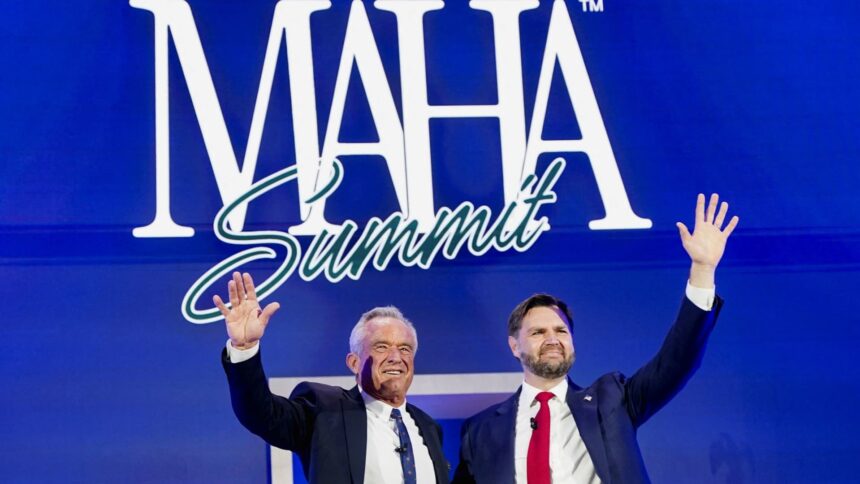
At the inaugural Make America Healthy Again (MAHA) summit held in Washington, D.C. on November 12, 2025, U.S. Vice President JD Vance and U.S. Secretary of Health and Human Services Robert F. Kennedy Jr. shared the stage, marking a pivotal moment for the coalition focused on promoting healthy food and rejecting harmful chemicals. However, the movement now faces significant challenges as a Supreme Court case and a critical farm bill slated for discussion in Congress threaten its cohesion.
The Supreme Court is set to hear arguments that could determine whether federal law supersedes state-level lawsuits claiming that glyphosate, the active ingredient in Bayer’s Roundup herbicide, is linked to cancer. Concurrently, the U.S. House plans to deliberate on the farm bill, which includes new protections for glyphosate, further complicating relations between MAHA advocates and Republican leadership.
MAHA played a key role in the political landscape, assisting President Donald Trump in regaining his position after Kennedy Jr. exited the presidential race and threw his support behind Trump. Despite this alliance, the coalition’s stance against glyphosate has put it squarely at odds with the administration and the majority of Republicans in Congress. Tensions have escalated since Trump signed an executive order promoting domestic glyphosate production, an action that triggered resentment among MAHA supporters and prompted Kennedy Jr. to intervene.
Kelly Ryerson, a prominent MAHA advocate nicknamed “the Glyphosate Girl,” expressed her concerns about the pressures facing the movement. “It has been a really, really rough few months because we have an attack coming from the executive branch, the judicial branch, and over in Congress,” she stated. Ryerson condemned the administration’s alignment with Bayer concerning glyphosate as indicative of a serious disconnect with MAHA’s values.
The Environmental Protection Agency (EPA), which oversees pesticide regulations, currently does not consider glyphosate to be a carcinogen and does not mandate cancer risk disclosures on its labels. This stance stands in stark contrast to numerous lawsuits alleging that individuals contracted cancer from using Roundup, with substantial settlements awarded to plaintiffs in the past. The federal government plans to argue that the Federal Insecticide, Fungicide, and Rodenticide Act shields Bayer from the myriad state-level claims if upheld in the Supreme Court.
The farm bill contains a section that MAHA advocates interpret as a “liability shield” for pesticide manufacturers, prohibiting states from adding labeling requirements beyond the EPA’s standards. House Agriculture Chair G.T. Thompson defended the bill, arguing it is grounded in scientific rigor and clarifying that states can still modify labels by working through the EPA.
Ryerson vehemently disagreed with Thompson’s characterization, indicating that the legislation indeed provides protections for pesticide companies and calling for a debate regarding the bill’s true implications. As frustrations mount, MAHA advocates are finding their political alignment increasingly precarious, potentially swaying undecided voters away from Republicans as the 2026 midterm elections approach.
Democratic representatives, including Chellie Pingree of Maine, perceive an opportunity to attract MAHA supporters by highlighting the rifts within the Republican coalition. Pingree noted that individuals inspired by the MAHA movement may be less committed to traditional party lines and more focused on which party advocates for their health-related concerns.
Ryerson echoed these sentiments, cautioning that disillusionment among MAHA members could lead to apathy at the polls, rather than a viable shift to Democratic candidates. To address these tensions, the White House recently convened with MAHA advocates to discuss their concerns and promote collaborative efforts. While Ryerson viewed the meeting as a productive step, she conveyed uncertainty about the administration’s ability to retain MAHA within its support base.
As the Supreme Court deliberations and the farm bill’s passage loom, the fate of the MAHA coalition, and its influence on Republican policies in the forthcoming elections, hangs in the balance.