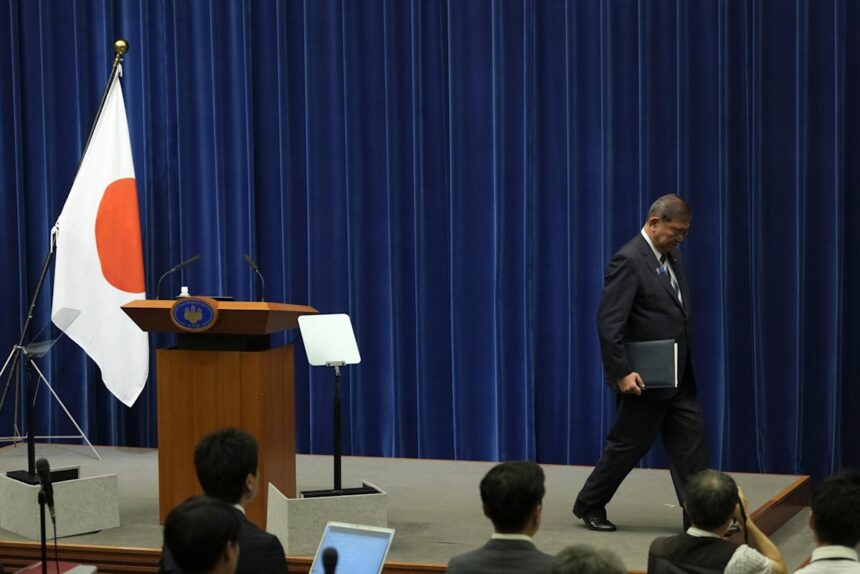
Japanese financial markets are bracing for a wave of uncertainty following the resignation of Prime Minister Shigeru Ishiba, who stepped down during a news conference in Tokyo. The potential impacts of his departure are reverberating through various sectors, with investors now contemplating the implications on fiscal policies and the Bank of Japan’s (BOJ) interest rate decisions.
The Japanese yen has already shown signs of weakness, falling as much as 0.8% against the dollar, and it was noted as one of the weaker currencies in the Group of 10 last week. Despite this, Japanese stocks saw a modest rally, with the Nikkei 225 index rising by 1.4% and the broader Topix index up by 0.9%. The dip in currency often boosts Japanese equities, creating a somewhat paradoxical response to Ishiba’s resignation.
Long-maturity Japanese government bonds (JGBs) appear particularly sensitive to market reactions amid growing concerns over government spending. In the morning trading session in Tokyo, these bonds went untraded, reflecting hesitance among investors. Meanwhile, the market for U.S. Treasuries showed a rally on Friday, which may mitigate some immediate reactions in Japan.
Market analysts are wary, especially given that the ruling Liberal Democratic Party (LDP) currently lacks a clear majority, which adds to the uncertainty. Charu Chanana, Chief Investment Strategist at Saxo Markets, pointed out that investor caution will likely elevate market volatility in the short term, affecting the yen, bonds, and equity prices until a successor is confirmed.
The yields on Japanese government bonds have already started to widen, leading to apprehensions about further repercussions in international debt markets. Katsutoshi Inadome, a senior strategist at Sumitomo Mitsui Trust Asset Management, emphasized that it is challenging to foresee a successor who would maintain fiscal discipline at a level comparable to Ishiba’s, suggesting sustained weakness in ultra-long-term bonds due to fiscal fears.
Market dynamics are also shifting. Interest seems to be gravitating towards the five versus 30-year sector, and as traders brace for a potential steepening of the yield curve, the implications of various candidates for Ishiba’s position are under scrutiny. The yen’s valuation, which ended last week at 147.43 to the dollar, is anticipated to approach 149.10/20 according to analysts, adding to the trading landscape’s unpredictability.
Nick Twidale from ATFX Global Markets mentioned that the ongoing political developments could push a BOJ rate hike off the table for the remainder of the year. With heightened volatility, currency options are reflecting increased implied volatility for the dollar-yen pair, indicating traders are preparing for fluctuating conditions. Meanwhile, swaps markets are currently not pricing in any rate adjustments by the BOJ in their upcoming meeting, potentially delaying expectations until April of next year.
Market sentiment concerning potential successors is varied. Possible candidates to step into Ishiba’s role include Sanae Takaichi, known for her favor towards stimulus measures, and Agriculture Minister Shinjiro Koizumi. Other contenders are Takayuki Kobayashi, former economic security minister, and current Finance Minister Katsunobu Kato. Strategies regarding each candidate’s approach to fiscal and monetary policy could sway market dynamics in different directions.
Ken Matsumoto, a macro strategist at Credit Agricole, highlighted that Takaichi’s dovish stance may be viewed favorably in markets, while Koizumi’s more neutral position could lead back towards prior trends. Conversely, Yoshimasa Hayashi’s fiscal hawkishness could result in a flattening effect should he gain the leadership role.
As the political landscape evolves, investor attention is likely to remain focused on who will take the reins as the next Prime Minister, along with the broader implications for Japan’s economic policies and global market stability.