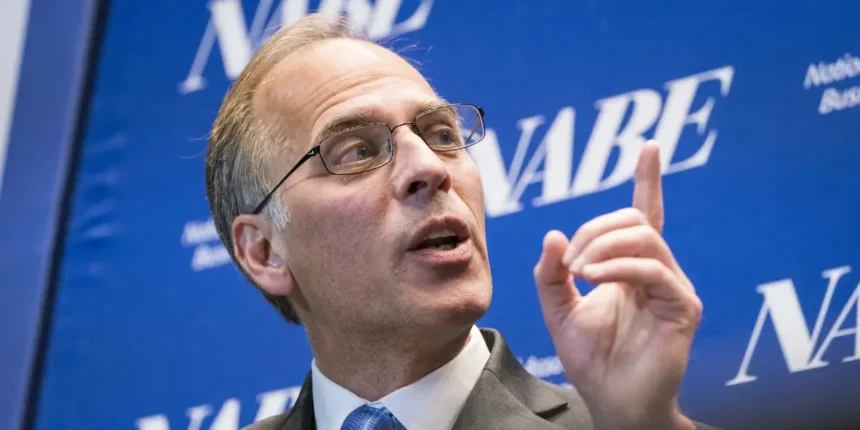
Moody’s chief economist, Mark Zandi, is raising concerns about a widening gap between the thriving stock market and the underlying economic conditions in the United States. Despite the S&P 500 recently closing above 7,200 for the first time ever, Zandi suggests that the stock market’s performance does not reflect the overall health of the economy.
In his latest newsletter, Zandi highlighted that nearly half of the market’s capitalization is being driven by technology companies, particularly those capitalizing on excitement surrounding artificial intelligence (AI). He emphasized that the current enthusiasm for AI indeed operates independently of broader economic challenges, including ongoing geopolitical tensions. This detachment is exemplified by instances such as sneaker manufacturer Allbirds, which recently rebranded itself as an AI company, triggering a surge in its stock price akin to a meme-style rally.
Moreover, Zandi pointed out that the recent bullish momentum in the stock market is not merely a result of AI-driven optimism. He noted that investor sentiment is partly fueled by the belief that former President Donald Trump might intervene to stabilize the markets should they encounter turbulence—a notion referred to as the “Trump put.”
Zandi asserted that the presidency often sees the stock market as a critical barometer for its success, leading to actions that prioritize stock performance, even to the detriment of military engagements. He warned that if stock prices begin to decline, it is likely that drastic measures might be taken to ensure a swift recovery.
Despite the stock market’s record-setting performance, Zandi reiterated his prediction that an economic recession may be on the horizon, with the ongoing conflict in Iran potentially serving as a pivotal factor. His projections indicate a 40% chance of recession within the next year, attributed to vulnerabilities in both the labor and housing markets, as well as the potential for additional economic disruptions.
Ultimately, Zandi concludes that the stock market’s record highs do not accurately portray the real prospects and performance of the economy. Instead, he foresees a scenario where political maneuvers could be prioritized over more disciplined economic policymaking, particularly in the context of maintaining public confidence in the market.