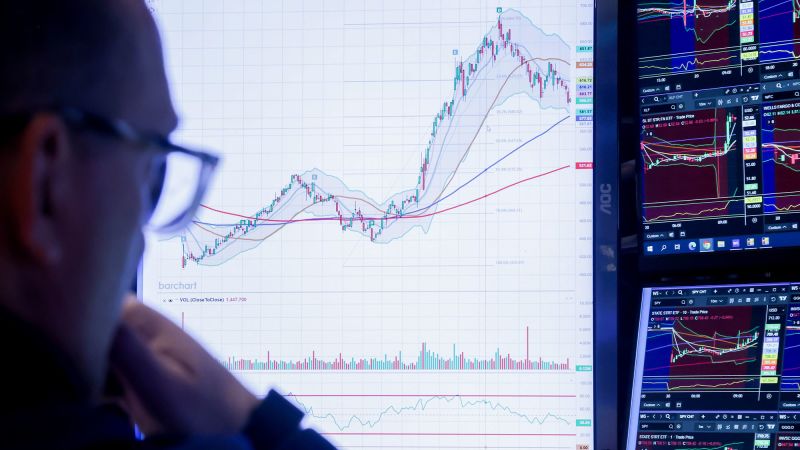
Gas prices have surged above $4, ceasefire negotiations remain stalled, and airlines are reporting dwindling jet fuel supplies. Despite these troubling signs, stock markets have reached record highs, raising eyebrows among analysts and investors alike.
A significant factor in this perplexing disconnect appears to be how media outlets, particularly CNN, frame current events in relation to market performance. The tendency to correlate these two spheres has shaped public perception, often leading people to see the stock market as a direct reflection of real-world events. However, experts argue that the stock market’s role is more nuanced; it functions as a predictive tool rather than a mere mirror reflecting current conditions.
Kevin Ford, a market strategist at Convera, emphasizes that stock fluctuations serve as indicators of how various factors—from promising earnings reports to unforeseen corporate challenges—impact the projected value of a company’s shares. Once the market absorbs the implications of significant news, it often shifts focus quickly, sometimes outpacing everyday realities that many on Main Street face.
Historically, markets have operated on what can be described as an “alternate timeline.” For instance, following the economic downturn in March 2009, stocks began to gain traction despite the ongoing recession. Similarly, markets rebounded just a month after the pandemic-induced global economic turmoil in early 2020. Even in the face of significant policy changes, such as former President Trump’s tariffs, stock values continued to rise.
However, the market does not operate devoid of context. Investors frequently price stocks based on anticipated profits. New developments—like geopolitical tensions—create uncertainty, forcing traders to reevaluate their positions. The recent conflict involving Iran illustrates this point vividly. As tensions escalated in late February, stock indices, particularly the tech-heavy Nasdaq, experienced sharp declines, entering correction territory. The Dow Jones and S&P 500 were not far behind.
Then, a shift occurred at the end of March as news suggested that the U.S. government was actively seeking resolution pathways. Perceptions of risk changed; markets reacted positively with the S&P 500 surging nearly 3% that day. Since then, stocks have continued to rise, defying the deteriorating economic situation, including the ongoing closure of the Strait of Hormuz—a critical passage for a significant share of global oil transport.
Despite persistent risks, market analysts believe that the risks have already been integrated into current stock prices. Nigel Green, CEO of deVere Group, notes that investors are not ignoring risk but rather assessing that the global economy and corporate earnings can withstand it—suggesting that the market often reacts before uncertainties become certainties.
Nevertheless, the predictive capabilities of the market are not infallible, and various scenarios could unfold. While peace negotiations can take extensive timeframes to conclude, the remnant risks—like supply chain disruptions—could spark a crisis, potentially pushing the economy towards recession.
Conversely, there is also the possibility that the market could overlook significant opportunities as it navigates immediate fears. Indicators of economic strength have been evident, such as strong corporate earnings and a booming tech sector driven by artificial intelligence investments. The Citi Economic Surprise Index—a barometer for economic performance against market expectations—has shown prolonged positive momentum, indicating that the market may consistently undervalue economic robustness.
Rick Gardner, the chief investment officer at RGA Investments, reinforces this duality, stating that while alarming headlines are genuine and concerning, they are often mitigated by exceptional earnings reports that can overshadow negative news for investors. This dynamic creates a complex landscape, where sentiment and numbers may tell different stories, and the future remains uncertain.