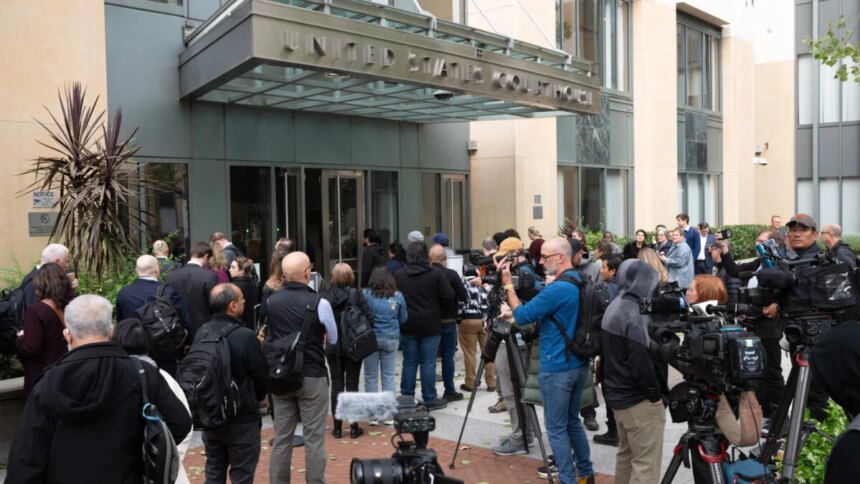
Elon Musk’s recent testimony in the legal battle against Sam Altman and OpenAI showcased a side of the tech mogul that is seldom seen in his usually controlled public demeanor. Unlike his typical interactions on social media where he often steers the narrative, in the courtroom, Musk grappled with intimidating cross-examination, creating a dynamic that kept reporters and observers captivated.
Central to Musk’s lawsuit is his assertion that OpenAI was initially envisioned as a non-profit organization aimed at benefiting humanity through artificial intelligence. He portrayed himself as a misled benefactor, having provided $38 million in founding capital under the impression that the venture would remain charitable in its aims. “It was specifically meant to be for a charity that does not benefit any individual person,” Musk stated. He expressed concern over OpenAI’s evolution into a for-profit entity, arguing that it poses a threat to the foundations of charitable giving in the country. “If we make it okay to loot a charity, the entire foundation of charitable giving in America will be destroyed,” he warned, emphasizing the gravity of this transformation.
Musk’s delay in filing the lawsuit drew scrutiny. He clarified that he only grasped the implications of OpenAI’s shift when Microsoft announced a substantial $10 billion investment in the organization in 2022. He remarked, “Microsoft would only put $10 billion into something if they feel like they will get a return,” suggesting that this investment hinted at a significant departure from charitable intentions. This realization propelled him into action, leading to the lawsuit six years post-departure from OpenAI.
Complicating Musk’s personal narrative is his relationship with Shivon Zilis, the mother of four of his children, who lives with him and has served in various capacities including as an advisor at OpenAI. During his testimony, he described Zilis in professional terms, referring to her as his “chief of staff.” Their relationship, however, is layered with complexity, particularly as she remained at OpenAI even after Musk left, at one point inquiring whether she should stay close to the organization to facilitate information flow.
Throughout the proceedings, Musk repeatedly invoked cultural references, particularly to science fiction and the potential dangers posed by AI. He expressed his desire to see AI developed with safety in mind, contrasting it against the dystopian futures depicted in films like The Terminator. “If we build the robots, I can make sure that they’re safe, and we don’t have a Terminator future situation,” he stated, highlighting his apprehension about unregulated AI development.
Despite his claims of calm and composure, Musk’s testimony exposed his struggle to maintain that façade under pressure. When confronted with past remarks he made about OpenAI employees, including derogatory language towards the safety team, he insisted, “I don’t lose my temper,” which quickly fell apart as his frustration became apparent during vigorous questioning. His emotional responses served as a stark contrast to the image he typically cultivates online.
Overall, Musk’s courtroom appearance not only revealed insights about his relationships and business dealings but also underscored the turbulent intersection of personal and professional stakes inherent in the rapidly evolving landscape of artificial intelligence.