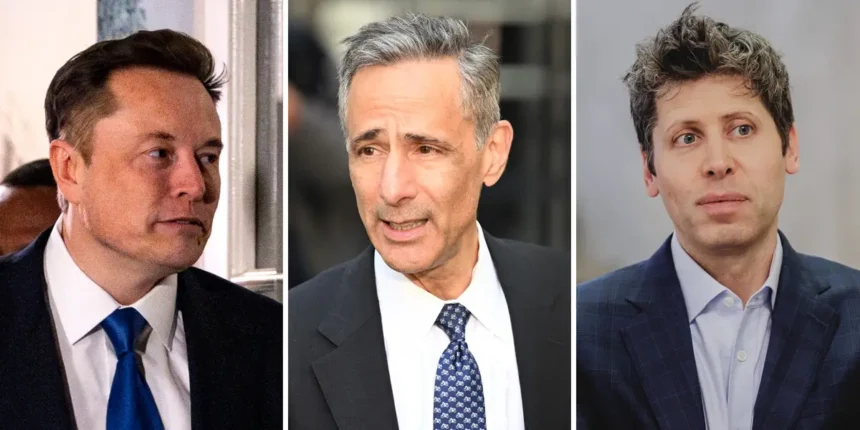
In a high-stakes legal battle that has caught the attention of the tech world, Sam Altman has turned to seasoned litigator William Savitt to represent him against Elon Musk’s allegations. Savitt, an attorney at the prestigious law firm Wachtell, Lipton, Rosen & Katz, previously led a successful case against Musk when he represented Twitter in 2022. That case revolved around Musk’s attempts to back out of a deal to purchase the social media platform, ultimately resulting in Musk agreeing to fulfill the terms of their agreement just before the trial commenced.
Now, Savitt is at the forefront of a major federal trial in Oakland, California, where Musk is suing Altman for allegedly transforming OpenAI, once envisioned as a nonprofit, into a significant corporate entity. Musk contends that this shift constitutes a scam, while Savitt’s task is to reveal Musk’s true intentions—undermining OpenAI to promote his own artificial intelligence venture, xAI.
Despite having a distinguished legal career and representing high-profile clients like Brad Pitt, Savitt remains relatively low-profile in the public eye. This trial represents a pivotal moment for him, placing him squarely in the spotlight amidst the ongoing tussle between two technology titans. Savitt possesses a calm demeanor, often displaying a composed and courteous manner inside and outside the courtroom. His demeanor belies a dynamic background; before embarking on his legal career, he drove a cab and played guitar in various rock bands, experiences he fondly recalls.
In the courtroom, Savitt’s tenacity is apparent. He adeptly grilled Musk, who claimed not to have read key documents about OpenAI’s organizational structure. Savitt’s pointed questioning revealed the simplicity of the document in question, showcasing his sharp litigation skills and deep understanding of the case.
Interestingly, Savitt’s connection to this conflict runs deeper than just representing Altman. The law firm, Wachtell, has been involved with Musk since it helped Twitter launch its lawsuit against him. Musk’s reaction to Twitter’s $90 million legal fee for Wachtell was explosive, leading him to allege institutional corruption against them—a case that was ultimately resolved confidentially.
Meanwhile, Savitt’s longstanding relationship with Altman dates back to Altman’s challenges within OpenAI in late 2023. The two have worked together on various confidential matters, with Wachtell assisting OpenAI in acquisitions and legal restructuring. When Altman decided to shift OpenAI’s profit-making capabilities into a public benefit corporation—something Musk is now contesting—Savitt was pivotal to the process.
Reflecting on his journey into law, Savitt’s past is as eclectic as it is inspiring. After spending his early adulthood immersed in music and various odd jobs to make ends meet, he transitioned into academia. After earning a degree from Brown University, he attended Columbia Law School and later clerked for the renowned Supreme Court Justice Ruth Bader Ginsburg. This experience was instrumental, molding his approach toward the law.
Savitt’s career trajectory took him to Wachtell, where he has established himself as a top-tier corporate litigator, known for taking on challenging cases with a meticulous eye for detail. His distinguished legal background includes successful defenses for major corporations and individuals, underlining his command over corporate law, particularly in the Delaware Chancery Court—an essential venue for complex business disputes.
The current trial not only signifies a personal milestone for Savitt, placing him in the national spotlight, but also represents a broader conflict between innovation and corporate ethics in the rapidly evolving realm of artificial intelligence. As the case unfolds, eyes will be on Savitt to see if he can articulate a compelling narrative that sways the jury in Altman’s favor and solidifies his reputation as a leading figure in corporate litigation.