Oil prices experienced a decline on Wednesday morning, driven by renewed hopes for a resolution to the ongoing conflict with Iran, which in turn boosted sentiment across global markets and pushed European stocks higher. This shift followed remarks from U.S. President Donald Trump indicating that the United States would momentarily halt its “Project Freedom”, a naval escort mission in the Strait of Hormuz, due to what he termed “great progress” in negotiations with Tehran.
In a post shared on Truth Social, Trump noted, “While the blockade will remain in full force and effect, Project Freedom (the movement of ships through the Strait of Hormuz) will be paused for a short period of time to see whether or not the agreement can be finalized and signed.”
Since the onset of the conflict on February 28, the Strait of Hormuz has been largely inaccessible, curtailing approximately 20% of global oil and gas supplies and leaving over 20,000 individuals stranded on vessels in the Persian Gulf. U.S. military officials previously indicated that a ceasefire with Iran was effectively in place, although lingering uncertainty persists regarding the situation’s resolution.
On the commodity front, crude oil futures saw a decline late Tuesday, with international benchmark Brent crude for next-month delivery falling by 1.3% to $108.47 a barrel, while U.S. benchmark West Texas Intermediate decreased by $1.37 to $100.90 a barrel. Despite this drop, oil prices remain significantly elevated compared to the approximate $70 levels observed prior to the conflict’s outbreak.
In further developments, European stock markets opened sharply higher on Wednesday, capitalizing on a global equity rally spurred by optimism surrounding artificial intelligence and a decrease in geopolitical tensions. Major European benchmarks rose over 1% in early trading, with the FTSE 100 increasing by 1.2%, Germany’s DAX climbing 1.8%, and France’s CAC 40 advancing nearly 1.7%.
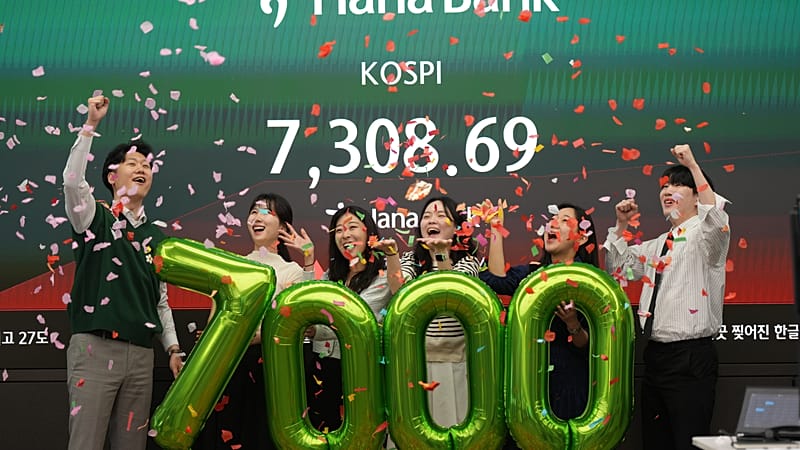
In Asia, South Korea’s Kospi index surged 6.5% to achieve a record high after markets reopened from a holiday. This rally was largely fueled by a remarkable 13% rise in Samsung Electronics shares, elevating the company’s market value beyond $1 trillion for the first time. Samsung, together with competitor SK Hynix, has positioned itself as a vital supplier of high-performance chips, essential for driving the ongoing AI boom. Shares in SK Hynix also experienced a notable increase of around 10% during early trading.
Other Asian markets exhibited positive movements, with Australia’s S&P/ASX 200 rising nearly 1%, Hong Kong’s Hang Seng gaining 0.7%, and Shanghai’s Composite index adding 1%. Japanese markets remained closed for a public holiday.
In the U.S., stock markets closed positively on Tuesday, with the S&P 500 rising 0.8% to set a new record high. The Dow Jones Industrial Average advanced by 0.7%, and the tech-heavy Nasdaq Composite climbed 1% to achieve another all-time peak. These market gains were bolstered by optimism regarding advancements in discussions aimed at resolving the U.S.-Iran conflict, which alleviated concerns surrounding energy supplies and potential disruptions to global trade.
Economic data emerging from the U.S. presented a mixed outlook. Growth in the services sector unexpectedly slowed last month, while separate statistics revealed that job openings slightly exceeded forecasts, underscoring the resilience of the labor market.
In the United Kingdom, government borrowing costs surged to their highest level in nearly three decades due to apprehensions regarding local elections and escalating energy prices. Yields on 30-year gilts reached 5.78%, the highest rate since 1998, while 10-year yields surpassed 5.10%.
In currency markets, the dollar remained relatively stable at 157.88 yen, while the euro saw a modest uptick to $1.1720. On the commodities front, gold futures rose by 2% to reach $4,662 an ounce, while silver prices increased by 3.5% during European morning trading.