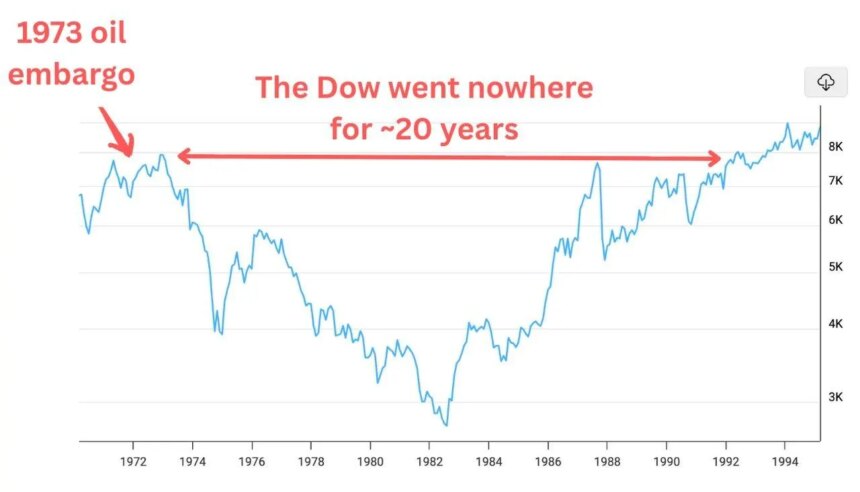
After the significant oil shock of 1973, the Dow Jones Industrial Average experienced a catastrophic drop of 40%, plunging into what later became known as a “lost decade” for investors. It took around 20 years for the index to recover fully, leaving many to ponder whether history could repeat itself amid current geopolitical tensions.
The striking similarities between the two eras cannot be overlooked. The context involves the same region, similar adversaries, and, notably, political motives that echo those of the 1970s. Presently, the situation has escalated to the point where the blockade of the Strait of Hormuz has potentially removed 20 million barrels of oil per day from the global market, equating to about 20% of the world’s supply. This figure is notably higher than the 4.5 million barrels per day that were effectively eliminated during the 1973 oil embargo.
Economist Paul Krugman, a Nobel laureate, emphasizes that comparing the immediate supply losses of 1973 does not capture the full picture. He argues that while the world oil supply only saw moderate losses at that time, it had been on a steep upward trajectory prior to the embargo. Consequently, in relative terms, the 1973 crisis led to an approximately 17.5% reduction in oil output by 1975, a figure in alignment with today’s challenges.
The aftermath of the 1973 oil crisis haunted the U.S. economy for decades, leading to double-digit inflation, the most severe recession since the Great Depression, and record-high unemployment. The stock market stagnated until the 1990s, prompting many to speculate on what a similar downturn could mean in the current landscape. Krugman estimates that today’s equivalent of that economic downturn could result in zero or negative growth for several years, posing a risk of a “global disaster.”
Krugman warns, “A comparable slowdown now would mean zero or negative world growth over the next two years, compared with the current IMF forecast of 3 percent. This would be a true global disaster,” underscoring the gravity of the situation.
Despite these alarming parallels, there are vital distinctions between now and 1973. One significant difference is that the global economy is far less reliant on oil compared to the 1970s. The U.S. has strategic oil reserves and is now a net oil exporter, providing a buffer against potential shortages. Other major economies are similarly better insulated, reducing the leverage any single nation might have to disrupt global oil supplies.
Additionally, this current oil shock is exclusively driven by actions from Iran. In contrast to the 1973 crisis, which involved a broader Arab OPEC embargo, other OPEC nations today have no intention of emulating Iran’s aggressive tactics. In fact, countries like Saudi Arabia are actively rerouting their oil supplies to minimize the impact from Iran’s actions.
Market analysts seem to reflect a sense of caution but also optimism regarding the potential for oil prices to stabilize. Presently, there is speculation that oil prices could retreat towards $60 per barrel by the end of the year, with an estimated increase of about 0.7 percentage points to headline inflation. This scenario hinges on the critical condition that the Strait of Hormuz reopens by summer.
In summary, while there are ominous parallels to the past, the resilience of today’s global economy and the unique geopolitical landscape may mitigate the impact of an oil supply shock, potentially averting a repeat of the dramatic downturn seen in the 1970s.