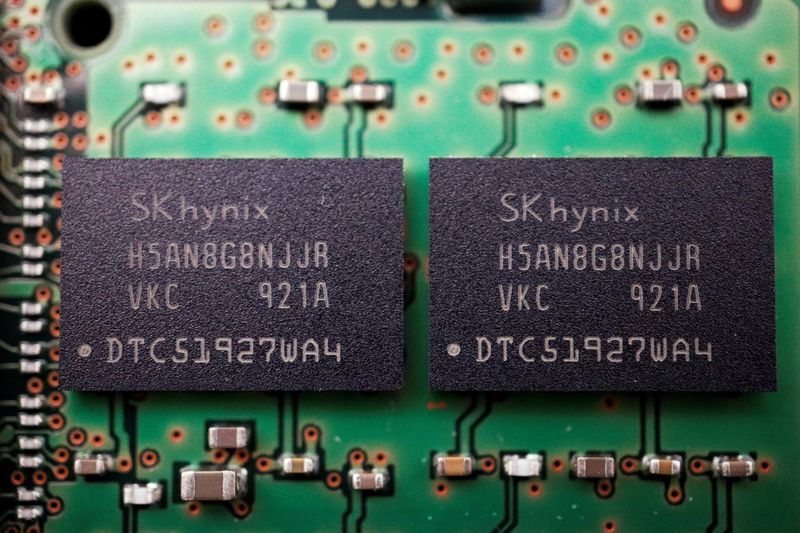
Individual investors are flocking to the semiconductor market, driving the Roundhill Memory ETF (DRAM) to unprecedented success since its launch on April 2. This exchange-traded fund has amassed over $6 billion in assets within just five weeks, surpassing even the remarkable debut of BlackRock’s iShares Bitcoin Trust in 2024.
The exceptional performance of DRAM highlights Wall Street’s enthusiasm for the booming demand in data centers, which is believed to be causing a lasting shortage of memory chips essential for artificial intelligence applications. According to Dave Nadig, chief investment officer at ETF Trends, the fund attracted its first $1 billion in assets in merely 10 trading days, and last Friday alone saw an influx of $1 billion in net investments during a single session.
Traders and market analysts view DRAM as an accessible avenue for investing in the semiconductor boom, particularly since it often can be challenging to select individual stocks. Unlike other semiconductor ETFs, such as BlackRock’s iShares Semiconductor ETF, DRAM includes exposure to major players beyond just the U.S.-listed Micron, incorporating South Korea’s SK Hynix and Samsung Electronics—companies currently enjoying record stock performance.
Steve Sosnick, a market strategist at Interactive Brokers, pointed out that many investors perceive DRAM as a proxy for attractive but less accessible Korean stocks. The fund also encompasses significant contributors from Japan and Taiwan’s semiconductor sectors.
Retail investors have played a pivotal role in DRAM’s swift rise. A recent analysis from Vanda Research revealed that self-directed investors purchased $55 million worth of the ETF in a single day—the largest influx recorded since its inception. This surpasses the investments these individuals made in notable stocks like Nvidia, indicating a broader interest in the semiconductor industry.
Vanda Research remarked that “DRAM is rapidly emerging as the poster child for the ongoing semiconductor frenzy.” Viraj Patel, a global macro strategist, noted the exceptional pace at which retail investors are flocking to this ETF, emphasizing that such swift accumulation in a short time frame is unprecedented.
However, significant inflows can also introduce volatility, as demonstrated by Tuesday’s sharp 7% decline in DRAM, coinciding with a broader retreat among chipmakers and a slight drop in the Philadelphia Stock Exchange Semiconductor Index. While many remain optimistic about the long-term prospects for memory chips, concerns are emerging about whether the segment may be overvalued, prompting fears of a market correction.
Despite recent fluctuations, Sosnick remains optimistic, observing that DRAM is still trading above recent moving averages, suggesting that the overall uptrend persists. As the semiconductor landscape evolves, investor sentiment will be closely monitored for signs of shifts amid the enthusiastic trading of this historic ETF.