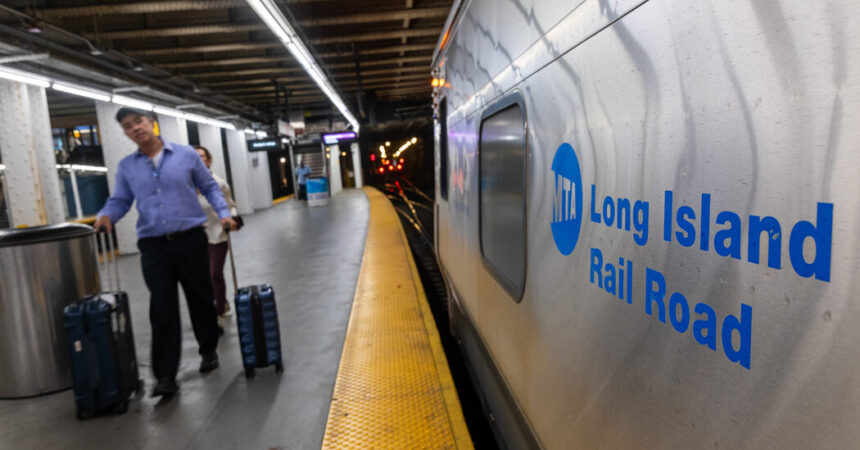
Thousands of workers from the Long Island Rail Road (LIRR) initiated a strike early Saturday morning, marking the first work stoppage for America’s busiest passenger railway in three decades. The move brought all service to a halt, affecting the over 270,000 daily riders who depend on the train line for their commutes between New York City and Long Island.
The strike was called by five unions representing more than 3,500 workers, including engineers, signalmen, and machinists, after extensive contract discussions with the Metropolitan Transportation Authority (M.T.A.) unraveled. Union representatives expressed their dissatisfaction over wage negotiations that had been ongoing for three years, citing a failure to agree on a suitable wage increase for 2026 and healthcare contributions.
Kevin Sexton, a vice president of one of the striking unions, the Brotherhood of Locomotive Engineers and Trainmen, expressed regret over the situation but emphasized the necessity of collective bargaining. “This is why you have to take collective bargaining seriously,” Sexton stated during a midnight press conference outside M.T.A. headquarters.
This strike poses significant travel challenges for commuters and leisure travelers, particularly as the New York Mets are scheduled to face the Yankees at Citi Field in Queens, where many fans from Long Island were expected to arrive by train. The M.T.A. announced plans to implement free shuttle bus services between specified locations on Long Island and two subway stations in Queens, starting Monday, although these services won’t fully alleviate the disruption over the weekend.
Governor Kathy Hochul, who is running for re-election, faces additional scrutiny amid the strike. She highlighted the investments her administration has made into the LIRR but cautioned that fulfilling unions’ demands could necessitate increased taxes or fare hikes of up to 8%. “The decision by some unions to strike over demands that would threaten that progress is reckless,” she stated.
M.T.A. CEO Janno Lieber indicated that while the agency was prepared to offer increased wages, the unions remained inflexible. The M.T.A. is constrained by its budget, which allocates nearly three-fourths of its annual operating budget of $2.2 billion to labor costs. Previous negotiations included discussions around modifying work rules that drive up labor costs, which the unions rejected, citing their importance to worker compensation.
Discussions in the days leading to the strike were characterized by minimal movement on both sides, with unions seeking a retroactive 9.5% wage increase for the last three years and a 5% raise in the current year—details the M.T.A. could not meet.
According to the state comptroller’s office, the strike could result in approximately $61 million in lost economic activity per day across the region. With more than 300,000 Long Island residents commuting to jobs in New York City, dependence on LIRR has only intensified since the pandemic.
As the strike progresses, union leaders refrain from providing an end date, labeling it an “open-ended strike.” Gilman Lang, the general chairman of the Brotherhood, stated, “We don’t know when it will end. It shouldn’t have begun.” With workers expressing their demands through picketing at various train stations, the immediate future of LIRR service remains uncertain.