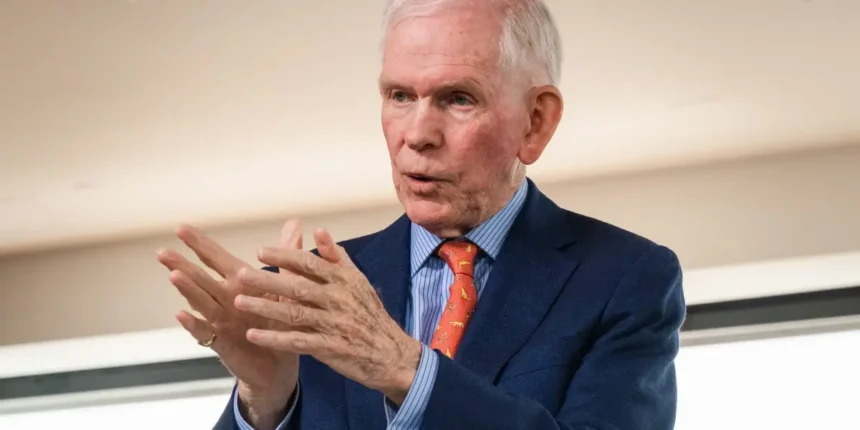
According to investing legend Jeremy Grantham, the trajectory of the US economy could have been vastly different without the significant influx of funding into artificial intelligence (AI). In a recent discussion on the Excess Returns podcast, Grantham expressed his concerns about the state of the economy and markets, predicting that the US would likely have faced a recession and a significant market downturn in 2023 without the boost from AI investments.
Grantham stated, “My guess is that in 2023 we would have moved into a recession and the market would have gone down another 25%. And AI headed it off.” He described the current economic landscape as “terra incognita,” highlighting the unprecedented level of AI investments as a percentage of GDP.
The AI surge has catalyzed a substantial spending spree among major technology companies. Amazon, Google, Meta, and Microsoft have collectively committed $725 billion in capital expenditures this year, with a large portion designated for AI development. This investment is projected to represent around 2% of US GDP by 2025.
Grantham speculated that without AI, GDP growth in 2023 might have hovered close to 0%. The rise in AI funding has also served as a stabilizing factor for the stock market, particularly noted in his reference to the “Magnificent Seven” tech stocks, which have played a crucial role in lifting the S&P 500 out of a bear market that persisted from late 2022 into early 2023.
He emphasized that the stock market was already experiencing a partial bubble before the excitement surrounding AI took hold, describing it as a situation where “we have a bubble forming out of a bubble that was only halfway completed, only halfway deflated, and then resuscitated.”
Grantham, known for his bearish market outlook and for predicting the dot-com bubble, has repeatedly warned about potential market crashes and downturns in recent years. In his upcoming memoir, “The Making of a Permabear: The Perils of Long-term Investing in a Short-term World,” he posits that the current AI bubble will likely “at least temporarily deflate.”
Earlier this year, during an appearance on “The Master Investor” podcast, he noted that the sharp rise in oil prices is another factor of concern, recalling that the US has a history of slipping into recession following such spikes in crude oil prices. The implications of these economic signals present a complex picture for investors and the broader market as the interplay of AI-driven growth continues to unfold.