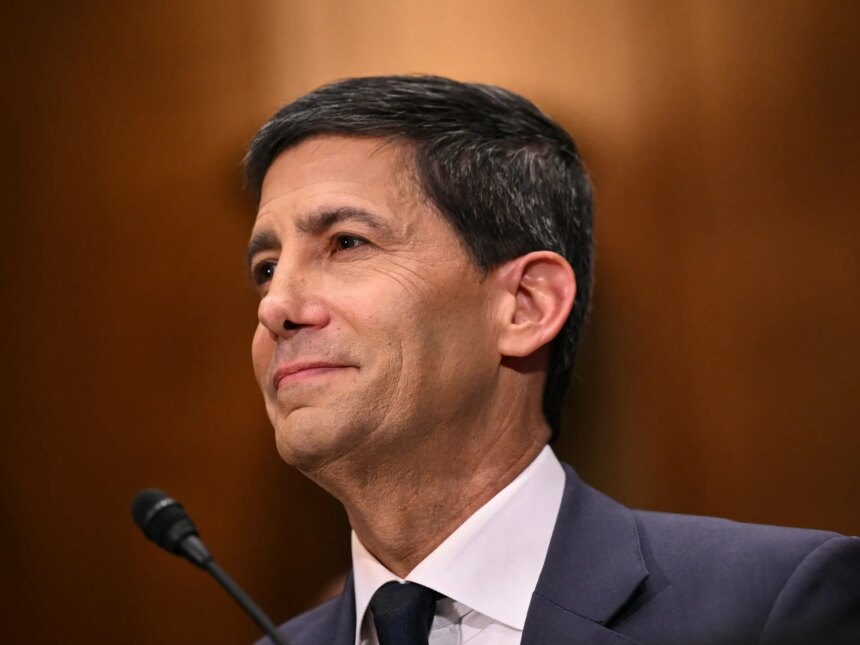
Kevin Warsh has officially taken office as the new chairman of the United States Federal Reserve Board of Governors, succeeding Jerome Powell, who held the position since 2018. Warsh’s swearing-in ceremony took place on Friday, following a contentious nomination process that witnessed the Senate voting predominantly along party lines for both his confirmation to the Board and appointment as chairman. Only Pennsylvania Senator John Fetterman broke ranks with his Democratic colleagues to support Warsh.
At 56 years of age, Warsh steps into this pivotal role amid growing scrutiny over the Fed’s independence, particularly in light of increasing political pressure on the historically non-partisan institution. President Donald Trump, acknowledging the concerns about Fed autonomy, emphasized the importance of independence in his opening remarks, urging Warsh to focus on his responsibilities without external influences. “I want Kevin to be totally independent and do a great job. Don’t look at me and don’t look at anybody. Just do your own job,” Trump stated.
During Warsh’s confirmation hearing before the Senate Banking Committee, Democratic Senator Elizabeth Warren accused him of being a “sock puppet” for Trump, a claim Warsh vehemently denied, asserting his commitment to maintaining an independent approach in making monetary policy decisions. It is notable that while Warsh previously advocated against cutting interest rates during Joe Biden’s presidency, his position shifted when Trump took office, as the former president insisted on appointing someone aligned with his views on rate cuts.
Despite Warsh’s leadership role, it is essential to recognize that he cannot dictate policy decisions independently; he will serve as one of 12 voting members. His inaugural policy meeting as chairman is scheduled for June 16-17.
The economic landscape presents Warsh with a complex challenge, particularly as the U.S. grapples with rising inflationary pressures. Recent data from the Labor Department’s Bureau of Labor Statistics indicated that consumer prices increased by 0.6 percent in April, following a 0.9 percent rise in March. Year-over-year, prices have escalated by 3.8 percent, marking the most significant increase in three years, with energy prices surging by 17.9 percent.
American consumers are bearing the brunt of these rising costs, particularly at the gas pumps, where the average price for a gallon of petrol now stands at $4.56—up from $2.98 on February 28 when the U.S. and Israel first engaged in conflict with Iran.
After his swearing-in, Warsh acknowledged the economic challenges ahead, stating that he is “not naive” about the persistence of inflation but expressed optimism that both inflation could decline and economic growth could remain robust. Nevertheless, the current inflation landscape may discourage the Fed from cutting interest rates. Analysts from JPMorgan Chase predict that rates are likely to stay steady until mid-2027, with a potential for increases rather than cuts.
Central bank officials have cautioned about the likelihood of persistent inflation, influenced by ongoing geopolitical conflicts and emerging price pressures unrelated to tariffs or energy. In line with this uncertainty, the CME Group’s FedWatch tool indicates a 97 percent probability that interest rates will remain unchanged at the upcoming policy meeting. The complexities of the economic environment and Warsh’s approach to leadership will be closely scrutinized in the months to come.