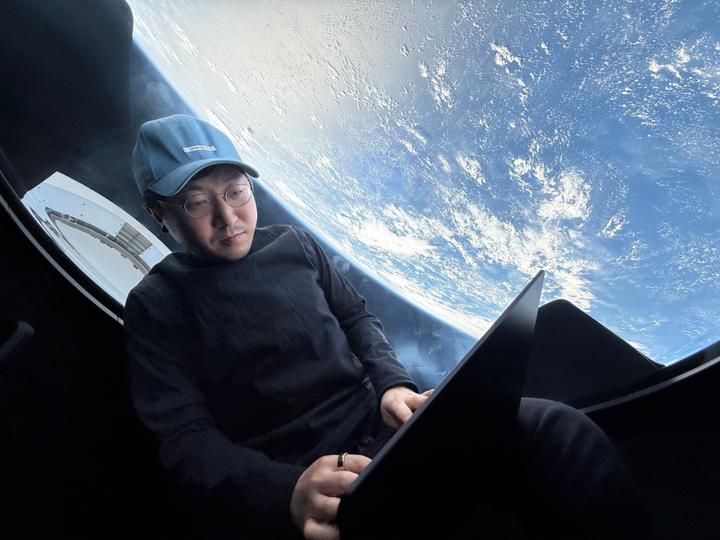
Chun Wang, a prominent crypto investor originally from China and a co-founder of the mining pool F2Pool, has been appointed as the Mission Commander for SpaceX’s inaugural commercial human spaceflight to Mars. This mission is a key component of Elon Musk’s grand vision to establish a human presence on the Red Planet, with aspirations to transport one million people there in the future.
Wang, whose mining pool contributes to approximately 11.3% of the global Bitcoin network’s hashrate, commands a personal fortune in Bitcoin assets that exceeds $300 million. As part of this groundbreaking opportunity, he will take a two-year leave from his current role in securing digital ledgers to focus on exploring the next frontier of human endeavor in deep space.
The announcement from SpaceX aligns with Musk’s ambitious plans to accelerate the colonization of Mars and the broader aim of creating a multi-planetary civilization. The timeline for this mission is notably ambitious and entails a week-long circumlunar fly-by, where Wang will traverse approximately 125 miles above the lunar surface alongside fellow astronauts, Dennis and Akiko Tito. This flight is a precursor to the critical launch towards Mars, scheduled for 2026, which will see the crew spend two consecutive years in the harsh environments of space.
The journey encompasses a comprehensive exploration of the Earth-Moon system, alongside a high-altitude fly-by of Mars, before embarking on a complex return trajectory to Earth. However, the planned expedition is not without its risks. Two years in deep space pose significant operational challenges, including hardware fatigue and the complex thermodynamic management of cryogenic fuels, especially during prolonged periods coasting in the vacuum of space.
To address these formidable challenges, SpaceX is set to introduce the next-generation Starship V3 architecture. This upgraded spacecraft includes advanced features such as vacuum-jacketed header feed lines, high-voltage cryogenic recirculation systems, and an array of 60 integrated custom avionics units capable of supporting distributed fault isolation at peak power levels of up to 9MW.
Wang’s mission also addresses critical biomedical risks. Among his responsibilities will be to carry out advanced behavioral health monitoring and capture the first human X-ray images in microgravity, crucial for understanding the physiological deteriorations that can occur with long-duration space travel.
The outcomes from this mission will provide essential operational data aimed at transitioning Mars exploration from initial short-term projects to the establishment of permanent and self-sustaining habitats on the planet. The findings from Wang and his team will directly evaluate Starship’s autonomous navigation capabilities, the effectiveness of deep-space radiation shielding, and the feasibility of in-space propellant transfer protocols.
Moreover, these insights will play a pivotal role in advancing Musk’s long-term goal of verifying rapid vehicle reuse and establishing a logistical framework necessary to transport millions of tons of cargo—and eventually one million people—to Mars.
This announcement coincides with SpaceX’s confidential filing for a public offering, potentially targeting a historical valuation exceeding $1.75 trillion. Additionally, it marks the first public disclosure of Musk’s company’s Bitcoin holdings, which total 8,285 BTC, further intertwining the realms of cryptocurrency and space exploration in what may be seen as a new chapter in both sectors.