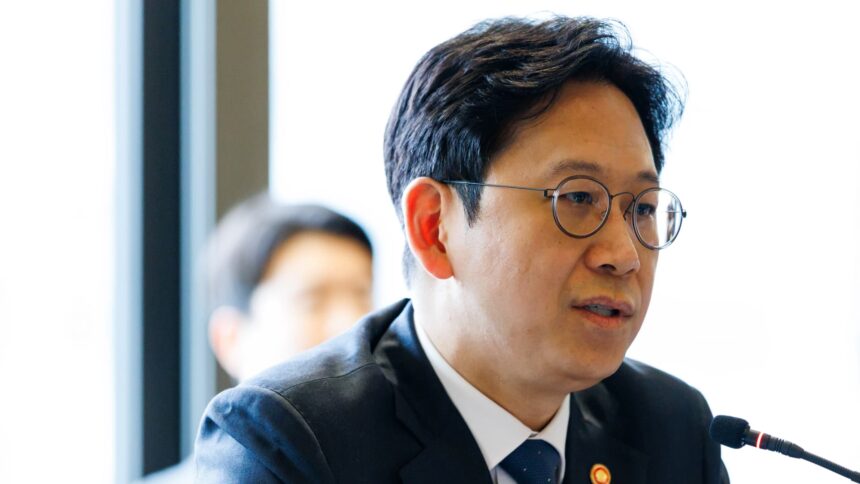
Bae Kyung-Hoon, South Korea’s Minister of Science and ICT, has emphasized the need for society to benefit from the wealth generated by artificial intelligence (AI) as the nation embraces the K-Moonshot project in collaboration with Google DeepMind. This initiative aims to leverage AI to tackle complex scientific challenges. During a recent memorandum of understanding signing ceremony in Seoul, Bae shed light on the broader implications of AI, particularly in the context of ongoing labor tensions at major conglomerate Samsung Electronics.
In an interview with CNBC, Bae articulated concerns regarding how the wealth created by AI might be distributed, the potential for increasing inequality, and the likelihood of job losses. He stated, “Recent labor-management conflicts can also be seen as part of this broader trend,” referring to negotiations with Samsung Electronics, where unionized workers recently suspended an 18-day strike in response to government intervention. The workers were advocating for the formalization of bonuses in their contracts and a payout of 15% of Samsung’s operating profits as bonuses. A tentative agreement was reached, and union members will vote on it soon.
Acknowledging the possibility of further industrial actions, Bae noted, “In the age of AI, more of these super-large companies will continue to emerge. In that process, labor-management conflicts may continue to arise, and when they do, it will be important to resolve them wisely through dialogue.” He also mentioned concerns regarding Hyundai’s integration of Atlas robots into its manufacturing, hinting at the wider implications of automation in the workforce.
Bae reiterated the need for South Korea not only to generate significant wealth through AI but also to ensure that the benefits of this technology reach the broader public. “We are deeply focused on building an ‘AI-inclusive society — a society where no one is left behind in the AI era,'” he stated.
His comments come in the wake of a proposal from South Korean presidential official Kim Yeong Beom, advocating for the distribution of excess tax revenue from AI and semiconductor sectors to citizens. The proposal, which ignited some market turmoil, was later clarified as Kim’s personal opinion rather than a formal government agenda.
Regarding the recent rally in South Korean markets, largely driven by tech giants like Samsung and SK Hynix, Bae acknowledged the significant gains in their stock prices. Samsung has surged nearly 144% year-to-date, while SK Hynix has experienced a remarkable increase of almost 200%. The Kospi index itself has soared more than 86% in 2026, surpassing last year’s gains.
When questioned about the concentration of gains within the tech sector, Bae responded by recognizing the strong position of these companies while also emphasizing the ecosystem that supports semiconductor production. He stated, “While these two companies clearly have their own strengths, there is also an ecosystem of related companies that support semiconductor production.”
Bae expressed optimism about South Korea’s ambitions in the field of physical AI, which encompasses AI technologies integrated into machines, vehicles, and industrial systems. He asserted that semiconductors and AI infrastructure provide the necessary foundation for this evolution, highlighting the nation’s commitment to developing a full spectrum of AI capabilities, including hardware, software, and associated services.