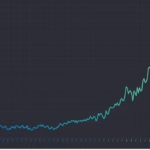
The remarkable surge of SK Hynix’s stock, which has skyrocketed over 250% this year, shows no signs of slowing down, driven largely by rising demand for artificial intelligence applications. Analysts suggest that the South Korean memory-chip manufacturer’s stock rally, propelling its market capitalization above $1 trillion, is indicative of a broader trend where companies involved in high-bandwidth memory chips for AI servers stand to benefit significantly.
Peter Kim, a global investment strategist at KB Securities, expressed confidence in the sustainability of the stock’s performance. Terming SK Hynix and Samsung Electronics as the “twin towers” of the memory-chip industry, he noted that the fundamentals and valuations of both companies remain strong. Despite their sharp stock price increases, Kim highlighted that earnings forecasts have been outpacing share price movements, making their valuations appear relatively inexpensive.
This sentiment is supported by U.S. memory giant Micron Technology, trading at about 12 times earnings, while SK Hynix and Samsung are trading at approximately six to seven times earnings based on analyst projections. “We’re still not halfway through this incredible rally,” Kim remarked, suggesting that the ongoing demand for chips continues to outstrip supply.
Dan Ives, an analyst at Wedbush Securities, echoed this optimism, branding the current artificial intelligence boom as being only in the “3rd inning of a 9-inning game.” He noted that demand for HBM, DRAM, and NAND memory has reached unprecedented levels. HBM is primarily used in AI accelerators and servers, while DRAM and NAND memory serve as essential storage solutions for countless electronic devices. Ives posited that SK Hynix stands as a core beneficiary of this “memory super-cycle,” cautioning that industry analysts may still be underestimating both the duration and impact of this growth phase.
While the outlook remains positive, concerns have been raised about market concentration risks within South Korea’s equity landscape. Samsung Electronics and SK Hynix dominate the Kospi, accounting for over 40% of the index, which raises worries about potential supply chain disruptions and an anticipated slowdown in global data center investment.
Kim pointed out the market’s polarized nature, where a few AI-centric stocks wield considerable influence over the overall market performance. Nevertheless, he contended that key risks typically known to end semiconductor upcycles—such as overcapacity—are not imminent. “Capacity will take at least a couple of years to come through,” he stated, reinforcing the belief that the current rally has more room to run.
Some investors have begun to adopt a more selective approach, particularly following the rapid gains witnessed in Asian semiconductor shares. Philip Wool, lead portfolio manager at Rayliant Global Advisors, noted that the fervor surrounding AI hardware is now penetrating emerging markets, beyond its previous confines within developed markets. Although he continues to invest in SK Hynix, Samsung Electronics, and TSMC, he asserted that these companies face a higher bar for outperforming, as investors now expect ongoing extraordinary levels of AI-related capital expenditures.
In conclusion, while the future for SK Hynix seems promising in light of the explosive growth in AI demand, the market dynamics present a mix of optimism and caution, urging investors to remain vigilant and selective amidst a rapidly evolving landscape.