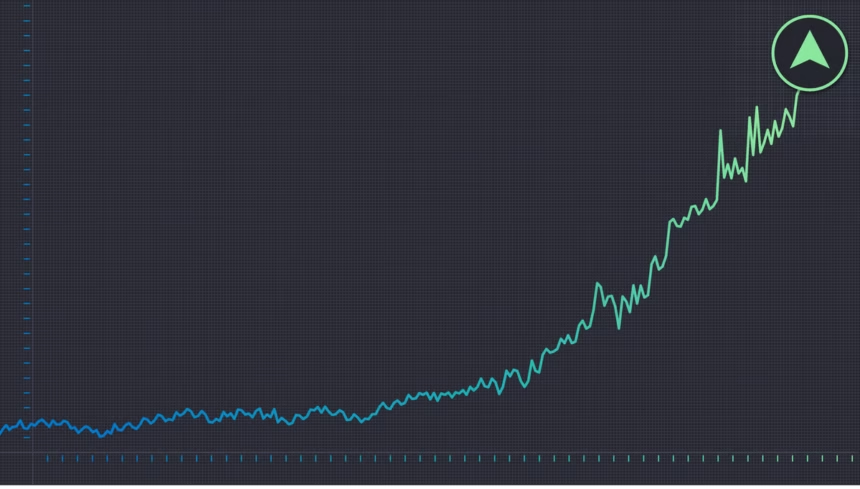
Micron Technology has achieved a remarkable milestone, surpassing a market value of $1 trillion on Tuesday, a feat few could have anticipated just a year ago. The memory chipmaker’s shares soared nearly 19% to reach a record high, positioning the company as the 10th most valuable enterprise in the United States, surpassing major players like Walmart and Eli Lilly.
This impressive ascent was largely fueled by a bold recommendation from UBS, which tripled its price target for Micron to $1,625. Should this target be reached, the company’s valuation would balloon to approximately $1.8 trillion, pushing it ahead of renowned brands such as Tesla and Meta Platforms, each valued at roughly $1.6 trillion.
The newfound optimism surrounding Micron stems from the transformative impact of artificial intelligence (AI) on the demand for memory chips. Historically, the company acted as a typical commodity producer, experiencing significant fluctuations in memory prices due to imbalances in supply and demand. However, analysts argue that AI has fundamentally altered these dynamics, leading to a more stable business model.
While tripling its market cap in comparison to industry giants like Tesla and Meta poses a significant challenge, Micron’s growth trajectory appears to lend some credence to this lofty ambition. In its fiscal second quarter of 2026, the company reported a near tripling of revenue from the previous year, reaching $23.86 billion, which also marked a substantial increase from $13.64 billion just three months prior. A significant portion of this revenue surge can be attributed to DRAM, the high-speed memory used in AI servers, alongside contributions from NAND storage chips.
Adding to the bullish sentiment, Micron announced a pivot in its sales strategy during its fiscal second-quarter earnings call. CEO Sanjay Mehrotra emphasized the implementation of multi-year contracts designed to provide more stability and visibility in revenue streams. The introduction of strategic customer agreements (SCAs) reflects a shift away from traditional long-term agreements (LTAs), with the company recently securing its first five-year deal.
This shift in business model could potentially justify a higher valuation for Micron, as long-term customer commitments might make the stock more appealing to investors typically cautious of cyclical chipmakers. Management remains optimistic about future performance as well, projecting third-quarter revenue around $33.5 billion and increasing the dividend by 30%.
Despite the stock’s substantial rise, it appears to be attractively priced relative to analysts’ earnings forecasts, trading at a forward price-to-earnings ratio in the mid-teens—a figure that is quite reasonable for a high-growth company, particularly one that is central to the ongoing AI revolution.
However, investors should remain cautious. The memory industry is traditionally cyclical, and the very factors propelling Micron’s growth—tight supply and escalating prices—historically have had a tendency to reverse sharply once new capacities come online. The company is poised to spend over $25 billion on capital expenditures in the current fiscal year, with even more expansion planned, a strategic move underscored by hopes for sustained AI demand.
This ambitious trajectory ties Micron’s fortunes closely to evolving market conditions, particularly in the AI sector. As such, if there are signs of demand cooling, market sentiment could shift swiftly, leading to a potential reevaluation of the stock’s valuation. Given Micron’s rapid rise into the top tier of U.S. corporations, this volatility remains a significant risk for investors to consider.