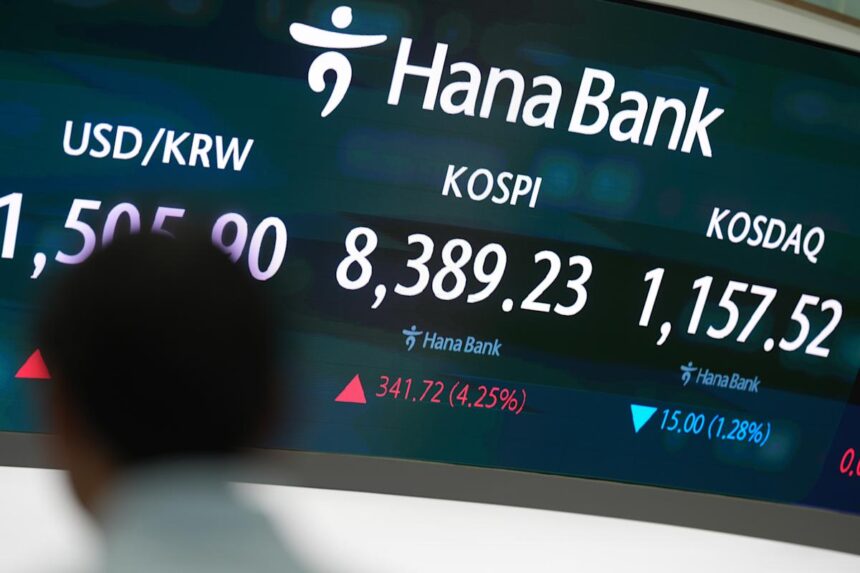
Asian markets largely saw gains on Wednesday, spurred by a rally in the U.S. stock market that reached new heights. South Korea’s Kospi rose almost 5%, while Taiwan’s benchmark index also experienced a significant surge, driven by a robust interest in artificial intelligence. The bullish sentiment particularly favored technology stocks and computer chip manufacturers.
In Tokyo, the Nikkei 225 index climbed 1.3%, closing at 65,816.62 and even breaching the 66,000 mark during intraday trading. Notable increases were seen in computer chip equipment makers, with Tokyo Electron’s shares jumping 5.9% and testing equipment firm Advantest gaining 5.7%.
The tech sector’s recent upswing was significantly influenced by a staggering 19.3% rise in Micron Technology’s stock, which catalyzed the S&P 500’s growth. Analysts from UBS raised their 12-month price target for Micron from $535 to $1,625, predicting ongoing strong demand for computer memory. Micron has seen its stock value more than triple this year, becoming one of the few Big Tech companies to surpass a market valuation of $1 trillion, joining giants like Nvidia, Apple, and Microsoft.
The enthusiasm surrounding AI investments has propelled South Korean and Taiwanese stocks to record highs. In Seoul, the Kospi reached 8,457.09, marking an all-time peak, with Samsung Electronics experiencing a 7% surge in its stock. The Taiex in Taiwan climbed 2.7%, reflecting similar positive trends.
Contrasting with the bullish sentiment in most parts of Asia, Hong Kong’s Hang Seng index fell by 0.7%, and the Shanghai Composite index declined by 0.2%. Meanwhile, Australia’s S&P/ASX 200 slightly increased by 0.1%.
On the previous day, U.S. markets set records, with the S&P 500 climbing 0.6% to 7,519.12 and the Nasdaq composite up 1.2% to 26,656.18. However, the Dow Jones Industrial Average saw a slight dip of 0.2%. U.S. stocks had been playing catch-up following global increases and comments from President Donald Trump about promising negotiations with Iran regarding a ceasefire, although the situation remains volatile with ongoing conflict in the region.
Oil prices have been notably influenced by this geopolitical unrest. The war ensuing from U.S. and Israeli military actions against Iran since late February has blocked the Strait of Hormuz, causing significant disruptions in oil supply and contributing to worldwide inflation. In response to potential improvements in oil flow, stocks of major airlines, such as United Airlines, rose by 6%, while Norwegian Cruise Line Holdings gained 4.9%.
Despite these gains, consumer sentiment in the U.S. has taken a hit due to rising inflation rates. A report released Tuesday indicated that consumer confidence dipped in May, although the decline was not as severe as some analysts had predicted. This followed a troubling report the previous week that recorded a consumer sentiment low.
As of early Wednesday, Brent crude oil prices fell by 94 cents to $95.73 a barrel, while U.S. crude oil dropped $1.35 to $92.54. The decline in oil prices had a favorable effect on U.S. bond yields, leading to a decrease in the 10-year Treasury yield from 4.56% to 4.48%. In currency markets, the U.S. dollar edged down against the Japanese yen, while the euro saw a slight increase against the dollar.