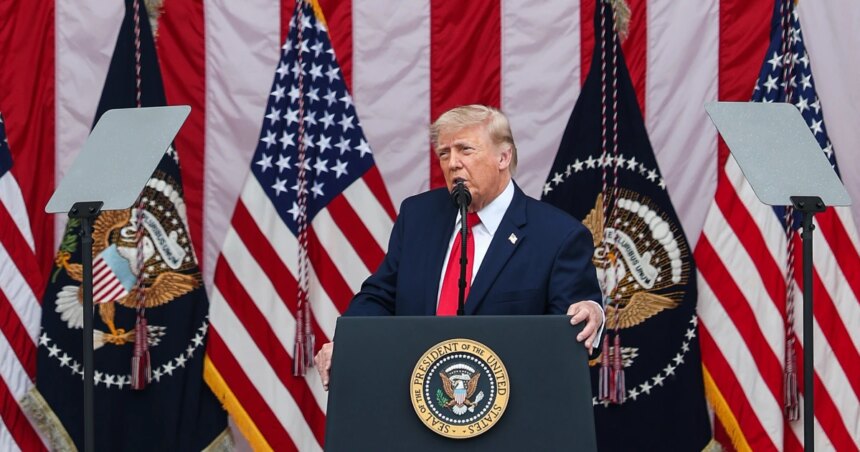
President Donald Trump emphasized the need to maintain the Commodity Futures Trading Commission’s (CFTC) exclusive jurisdiction over prediction markets during a recent post on Truth Social. He expressed strong support for ensuring that these markets can flourish under federal regulation, dubbing the forthcoming regulatory framework the “Gold Standard for the States.” Trump warned that other nations are eager to dominate this emerging financial sector and sought to reassure the American public of the nation’s leading position in both prediction markets and the cryptocurrency arena.
In his statement, Trump also highlighted the necessity of protecting the interests of the cryptocurrency industry, which he claims is currently the capital of digital currencies. He asserted that other countries are attempting to usurp that status but vowed that such efforts would not succeed.
This declaration followed a significant investigation by The New York Times, which unveiled that the CFTC has been instrumental in advancing prediction markets while simultaneously relaxing regulatory scrutiny on digital currencies. The report indicated that this shift occurred amidst changes that included reshaping the commission’s workforce and diminishing the influence of long-standing career officials.
The Trump family has notable financial connections to the prediction market space as well as to various cryptocurrency ventures, including World Liberty Financial. Additionally, Trump Jr. has affiliations with Kalshi and Polymarket, leading platforms in the event-contract betting sector.
However, the fate of prediction markets is currently in limbo, facing escalating scrutiny from state officials who claim these platforms operate outside legal gaming frameworks. The debate centers around regulatory authority: whether prediction markets should fall under federal oversight akin to securities or commodities markets, as advocated by Trump and his supporters at the CFTC, or be regulated at the state level under gambling laws, as argued by numerous governors and state attorneys general.
In a notable recent move, Minnesota Governor Tim Walz signed legislation that effectively bans prediction market platforms from operating in the state. This law marks a significant development as the first of its kind in the United States. The Trump administration responded swiftly with a lawsuit challenging the law and asserting the CFTC’s regulatory authority.
In his post, Trump specifically called out Governor Walz and several other local officials who have been pushing for tighter regulations on prediction markets. Among them is New York Attorney General Letitia James, who has been critical of cryptocurrency companies, recently suing Coinbase and Gemini for allegedly conducting illegal gambling operations through their prediction market activities. Both companies maintain that they operate under federal regulation and should not be subject to state-level oversight.
As the legal battle unfolds, the determination of whether prediction markets will be considered a federal commodity or fall under state gambling regulation will have significant implications for the future of this emerging sector in the U.S.