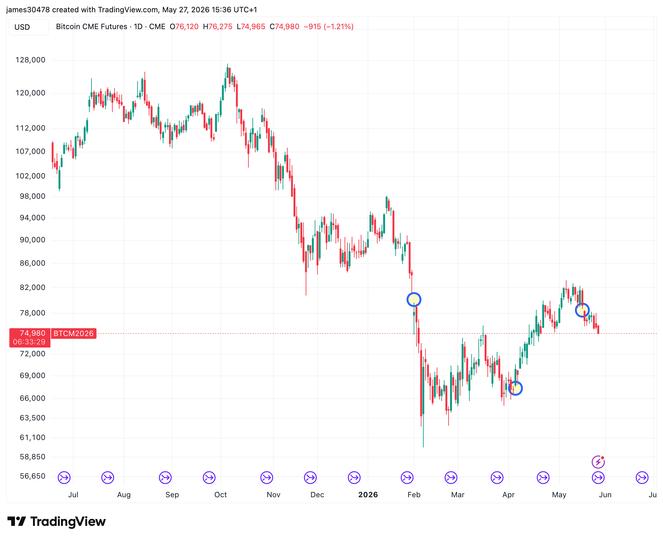
CME Group has officially transitioned to an always-on crypto market, commencing 24/7 trading of Bitcoin futures and options on its Globex electronic trading platform. This significant change took effect on Friday, marking a notable shift in how Bitcoin futures can be traded. The trading hours will only pause for a 60-minute maintenance window every Sunday from 10 PM to 11 PM UTC.
Historically, the limited trading hours imposed by CME had created pronounced inefficiencies in the Bitcoin market. Traders often reacted to the gap between Friday’s market close and Sunday’s reopening. This phenomenon led to strategies focused on “gap fills,” where traders would speculate on price corrections as the market adjusted to the developments that occurred over the weekend in the broader Bitcoin spot market.
Weekend trading traditionally suffered from low liquidity, which exacerbated price fluctuations. Traders often witnessed sharp volatility at the 11 PM UTC reopening as futures markets recalibrated to reflect the drift in spot prices over the weekend. This environment, characterized by thin order books, frequently resulted in exaggerated price moves, which would often revert as institutional traders began to engage with the market late Sunday.
Now, with CME adopting continuous trading, the historical gap that defined Bitcoin’s weekend trading dynamics has largely been eradicated. This alignment with Bitcoin’s inherent 24/7 market structure is expected to reduce weekend risk premiums and enhance hedging efficiency for institutional players, including asset managers, hedge funds, and corporate treasury desks, who can now more effectively manage their exposures without delays.
However, despite this significant step, CME still finds itself trailing in terms of overall liquidity in the cryptocurrency market. Cole Kennelly, founder and CEO of Volmex Labs, noted that BlackRock’s IBIT ETF options feature open interest amountsing to approximately $27 billion to $30 billion, significantly overshadowing CME’s Bitcoin futures options, which stand around $800 million to $900 million. This disparity underscores why the BVIV-US Index, associated with IBIT’s deeper options market, has become the preferred benchmark for institutional investors assessing Bitcoin volatility.
While the offshore perpetual futures and ETF options market may continue to lead in dominance for the moment, CME’s move to 24/7 trading alleviates a key point of friction. Currently, there are three open CME gaps from this year alone: two are positioned above Bitcoin’s current spot price of approximately $73,000—one created in late January around $80,000 and another around $78,500—and the third is situated just below the market at slightly under $70,000.