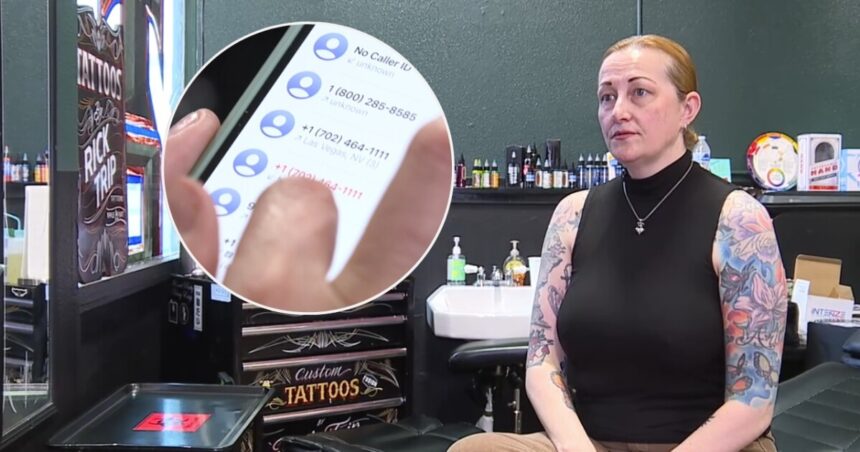
A Las Vegas woman, Stefanie Clary, recently endured a harrowing five-hour ordeal after she received a phone call about missing jury duty. This seemingly routine communication escalated into a nightmare, with scammers posing as law enforcement officials convincing her that she faced an imminent arrest, resulting in a loss of $12,500.
The incident began around noon on May 12, when Clary answered a call from an individual claiming to be a lieutenant. Initially doubtful about the legitimacy of the claim that she had missed federal jury duty, Clary was soon threatened with police action. The caller warned her that failure to comply would lead to immediate arrest at her home.
Feeling the pressure, Clary reported that the callers seemed to possess personal details about her, including her address. They employed legal jargon and informed her that she was under a “gag order,” warning her against discussing the issue with anyone, including her husband.
“They said you can’t tell anybody about this because it’s a court case that’s really, really hush-hush,” she recounted. The callers kept Clary on the line for over five hours, during which they spoofed a genuine Clark County constable’s office phone number, further solidifying their guise of authority.
Overwhelmed and in a state of panic, Clary was directed to an Athena Bitcoin ATM in downtown Las Vegas, where she withdrew and deposited $5,000 in cash. But the demands did not stop there; she ultimately deposited a total of $12,500 before the scammers instructed her to meet at a government building to resolve the supposed case against her. Upon arrival, however, Clary discovered the location was empty, leading to a crushing realization.
After this traumatic event, Clary reported the incident to the Metro police, the FBI, and the Federal Trade Commission (FTC). Her case was timely in light of recent warnings from the U.S. District Court for the District of Nevada about the rising prevalence of jury duty scams. The court confirmed the uptick in cases where individuals impersonate law enforcement or court officials, stressing the importance of contacting local authorities for anyone suspecting they have been scammed.
In a related note, a lawsuit targeting Bitcoin ATM operator Athena Bitcoin alleges that scammers frequently direct victims to cryptocurrency ATMs during schemes rooted in threats and impersonation. According to the lawsuit, as much as 93% of deposits at Athena machines in Washington, D.C. during a certain timeframe were connected to fraudulent activity. Athena, however, has denied any wrongdoing.
Clary expressed deep regret over the incident and has found it difficult to process the experience, saying, “I blamed myself so many times. I was so mad at myself.” She hopes that sharing her story will help others recognize the red flags in similar scenarios, urging others not to trust such calls unconditionally.
Both the FBI and FTC advise that law enforcement agencies will never request payments via Bitcoin ATMs, gift cards, or cryptocurrency. KTNV also reached out to Athena Bitcoin for comment on whether they could assist in refunding Clary’s lost funds but has not yet received a reply.