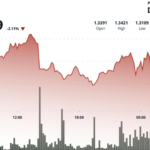
XRP, the digital currency associated with Ripple, has experienced a notable decline of approximately 26% since the start of 2026, currently trading around $1.34. This is significantly lower than its peak of $3.65 reached in July 2025, even after the resolution of a prominent SEC lawsuit, the launch of spot exchange-traded funds (ETFs), and the progress of the CLARITY Act through the Senate Banking Committee.
In February 2026, Standard Chartered revised its price target for XRP from $8 to $2.80, a dramatic 65% reduction. However, the bank also upgraded its long-term forecasts, projecting prices of $7 in 2027, $12.60 in 2028, $19.60 in 2029, and $28 by 2030. Achieving this ambitious roadmap hinges on the successful passage of the CLARITY Act and the need for ETF inflows to surpass $4 billion.
Despite advancements in institutional adoption and significant milestones for Ripple, including ten major deals and the XRP Ledger hosting $3.5 billion in tokenized assets, the price of XRP has remained largely stagnant. Industry analysts suggest that the future of XRP beyond 2026 hinges on transforming various positive trends into direct, sustained demand for the token.
Ripple has made notable strides in building its infrastructure, increasing daily transactions on the XRP Ledger to 3 million and witnessing a significant rise in the market cap of RLUSD to $1.72 billion within a year. Moreover, Ripple’s acquisition of Hidden Road has paved the way for XRP to be integrated into major financial systems, including the DTCC’s NSCC participant directory, enhancing its relevance in high-volume settlements.
The continued expansion of On-Demand Liquidity (ODL) corridors and the growth of tokenized assets are seen as potential catalysts for increasing XRP demand. However, only 40% of RippleNet’s 300 banking partners currently utilize ODL, which directly involves XRP transactions. The remaining 60% rely on Ripple’s messaging infrastructure, which does not engage with XRP. The passage of the CLARITY Act could eliminate the legal uncertainty surrounding XRP, potentially encouraging more of these partners to adopt ODL.
Alongside these factors, the performance of spot XRP ETFs, which launched in late 2025, will play a critical role in the token’s future. By late May 2026, these ETFs had attracted $1.41 billion in cumulative net inflows. Analysts project that inflows could reach between $4 and $8.4 billion if the necessary legal framework is established, suggesting that institutional investments would significantly enhance demand for XRP.
The outlook for XRP remains uncertain, with its future prospects contingent upon multiple variables, including legislative actions and the conversion of Ripple’s banking partners to ODL. Without substantial growth in direct XRP demand from its existing expansion efforts, the currency may find itself subject to broader market trends rather than its own intrinsic developments. As such, Ripple’s ongoing initiatives and the performance of regulatory changes will be critical in determining XRP’s trajectory beyond 2026.