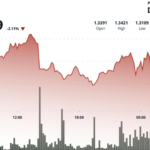
The US Dollar (USD) is experiencing slight gains on Monday, as market sentiment declines amidst escalating tensions in the Middle East and rising oil prices. The US Dollar Index (DXY) is displaying limited movement, lingering within the lower range of its trading band over the past two weeks. This index has struggled to maintain positions above the critical threshold of 99.00, particularly in light of upcoming key macroeconomic reports from the US.
Compounding the market’s caution are recent skirmishes involving the US and Iran, raising concerns about the stability of an already fragile ceasefire. While US President Donald Trump contemplates a memorandum aimed at extending the ceasefire for an additional 60 days, Israeli military operations in Lebanon are exerting further pressure on the delicate truce.
In terms of economic indicators, the US has a busy day ahead, starting with the ISM Manufacturing Purchasing Managers’ Index (PMI) report set for release later today. This report will serve as a prelude to a series of employment-related figures, culminating in Friday’s highly anticipated Nonfarm Payrolls report. These data points are likely to offer greater clarity regarding the monetary policy trajectory of the US Federal Reserve.
From a technical standpoint, the DXY is exhibiting signs of an expanding wedge formation, which is often indicative of heightened market volatility. Currently trading at 98.97, the Dollar Index shows a slight bearish bias, with momentum indicators pointing to potential struggles for upward movements. Specifically, the 4-hour Relative Strength Index (RSI) sits around 45, having failed to break through the pivotal 50 midline. Meanwhile, the Moving Average Convergence Divergence (MACD) remains marginally negative.
The resistance levels for any upswing are currently capped below session highs at $99.08, which poses challenges toward reaching the May 29 high near 99.20 and the subsequent May 28 high above 99.50. On the downside, a breach of the wedge’s lower boundary at 98.80 could lead to revisiting the May 5 and 13 highs near the 98.60 mark, followed by the May 8 and 11 lows positioned around 97.85.
The following table indicates the percentage changes of the US Dollar against several major currencies today, showcasing its relative strength, particularly against the New Zealand Dollar:
| Currency Pair | Change |
|—————|———-|
| USD/EUR | 0.00% |
| USD/GBP | -0.16% |
| USD/JPY | 0.11% |
| USD/CAD | 0.13% |
| USD/AUD | 0.02% |
| USD/NZD | 0.39% |
| USD/CHF | 0.28% |
The heat map illustrates the percentage fluctuations of various major currencies relative to one another, with the USD showing notable strength, especially against the New Zealand Dollar.