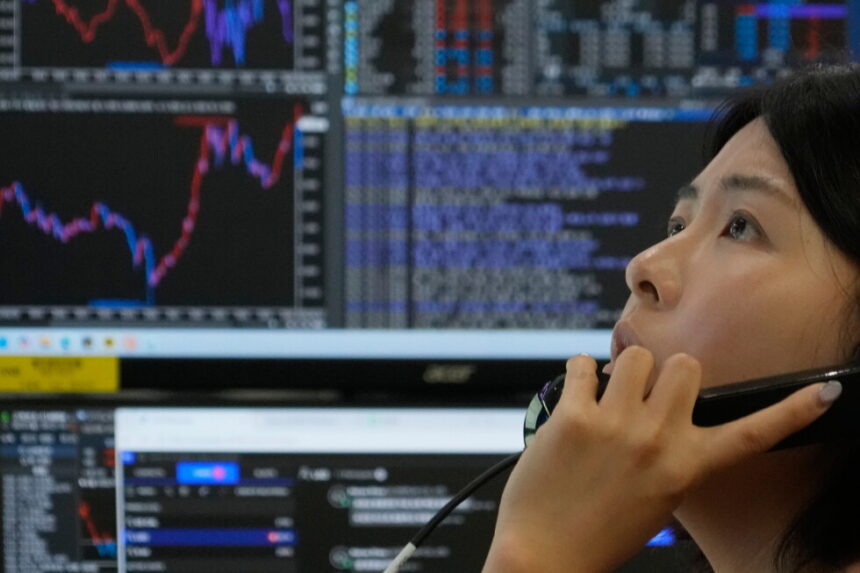
Stock markets in Japan and South Korea achieved new record highs amid a backdrop of escalating tensions between the U.S. and Iran, with global investors keeping a close watch on ongoing negotiations related to the Iran war ceasefire. Oil prices surged more than 3% as discussions on the reopening of the Strait of Hormuz, a critical passage for oil and natural gas shipments, continued. The U.S. military confirmed strikes on Iranian military sites in retaliation for Iran’s downing of a U.S. drone, intensifying geopolitical uncertainties.
U.S. futures indicated a positive market sentiment ahead of the European trading session, with Britain’s FTSE 100 slightly down by 0.1% to 10,396.16. Conversely, France’s CAC 40 rose by 0.2% to 8,202.53, and Germany’s DAX witnessed a 0.4% increase, closing at 25,198.34.
In Asia, the day was marked by significant gains, particularly in Japan and South Korea, where technology stocks played a pivotal role in pushing benchmarks to record levels. Tokyo’s Nikkei 225 Index rose by 0.9%, hitting an unprecedented close of 66,934.33, and briefly surpassing 67,000 during trading hours. SoftBank Group shares soared by 14%, propelling the investment firm to become the most valuable listed company in Japan, overtaking automotive giant Toyota.
The South Korean market also experienced a robust day, with the Kospi index climbing 3.7% to end at 8,788.38, setting a record. Samsung Electronics, the nation’s largest company, reported a 10.1% increase in stock value following the release of official data indicating a year-on-year export surge of 53% for May, driven largely by global semiconductor demand.
The Nikkei 225 has seen an impressive gain of over 12% over the past month, while the Kospi has surged approximately 27% in the same period. Meanwhile, Hong Kong’s Hang Seng Index rose 0.9% to close at 25,398.18, but the Shanghai Composite edged down 0.3% to 4,057.74 amid signs of weakening factory activity in China.
Elsewhere, Australia’s S&P/ASX 200 experienced a slight dip of less than 0.1%, while Taiwan’s Taiex climbed 1.4%. In contrast, India’s Sensex fell by 0.7%. The ongoing uncertainty surrounding the Iran war and its potential resolution continues to sway market movements and oil prices, even as optimism surrounding strong corporate earnings and demand for artificial intelligence (AI) technologies keeps stock markets buoyed.
U.S. President Donald Trump held strategic discussions with advisors regarding a potential 60-day extension of the Iran war ceasefire, but the outcome remains undecided. The fate of the Strait of Hormuz’s reopening also hangs in balance, with U.S. maritime forces maintaining a blockade on Iranian ports. Additionally, the Israeli military has been active in Lebanon, targeting Iran-backed Hezbollah, adding further complexity to the geopolitical landscape.
Brent crude oil saw a notable rise of 3.3% to $94.16 per barrel, significantly up from around $70 prior to the onset of the conflict. Meanwhile, benchmark U.S. crude climbed by 3.9% to reach $90.78 per barrel.
Market analysts remain cautiously optimistic amid the ongoing turbulence, with some positing that the reopening of the strategically significant Strait of Hormuz is likely sooner rather than later. Last week, Wall Street achieved additional record highs, bolstered by the performance of major technology stocks; the S&P 500 added 0.2%, reaching 7,580.06, marking its seventh consecutive gain. The Dow Jones Industrial Average rose 0.7% to 51,032.46, while the Nasdaq composite gained 0.2%, closing at 26,972.62. Notable performers included Dell Technologies, which spiked 32.8% following better-than-expected earnings and a positive outlook on AI demand. Meanwhile, Microsoft and Broadcom saw increases of over 5% and 4.7%, respectively.
In currency markets, the U.S. dollar appreciated against the Japanese yen, rising to 159.47 from 159.25. Conversely, the euro traded down at $1.1650, a slight decline from $1.1667.