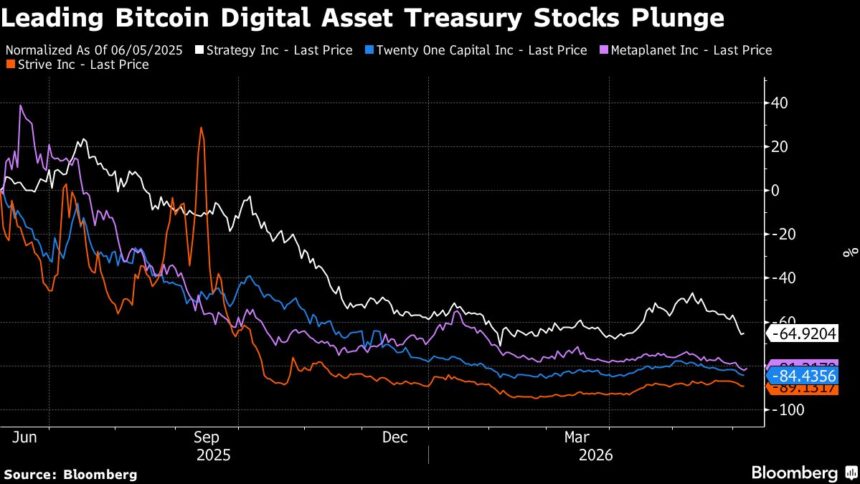
This week’s decline in Bitcoin prices has intensified pressures on a novel financial model developed during the recent cryptocurrency boom—companies publicly traded for the purpose of accumulating digital assets on behalf of investors. The shares of numerous digital-asset treasury companies have nosedived alongside the broader market downturn, experiencing losses that often far exceed the drops seen in the cryptocurrencies they were designed to hold.
According to data from Artemis, the combined market value of these Bitcoin treasury stocks has plummeted from nearly $134 billion in early October to approximately $72 billion now, reflecting a staggering $62 billion loss. Bitcoin itself has suffered a 14% drop this week, landing at four-month lows, a decline partially triggered by Michael Saylor’s Strategy Inc. announcing its first Bitcoin sale since 2022. While this retreat has not mirrored the chaotic crash from last October, companies that once thrived on the notion of a relentless crypto bull market find themselves increasingly focused on survival. Many are resorting to measures like reverse stock splits, issuing preferred securities, and restructuring financing arrangements, and in some cases, are beginning to sell portions of their previously pledged crypto holdings.
Hayden Hughes, managing partner at Tokenize Capital, noted that the current market conditions force these digital-asset treasuries into a difficult position: whether to default on their debt or to liquidate some assets. This forced selling has eroded the prevailing belief that they would act as consistent ‘buy and hold’ investors in the long term.
The premise behind digital-asset treasury companies, or DATs, was relatively straightforward: public markets would reward firms willing to stockpile cryptocurrencies, enabling them to issue stock, acquire more tokens, and repeat the cycle. This model flourished during Bitcoin’s price rises but has shown greater vulnerability as market prices recede and investor sentiment becomes more discerning. The latest Bitcoin decline only heightens these challenges, as the cryptocurrency has lost about half its value since its October high.
The trading dynamics have shifted significantly, allowing early investors and sponsors to reap substantial rewards during the peak of the digital-asset treasure cycle. However, the prevalent pressures have disproportionately affected retail investors who are facing significant losses as valuations decline. Akshat Vaidya, co-founder and managing partner of Maelstrom, pointed out that corporate holdings of Bitcoin now surpass 5% of its supply, which, while fostering adoption on Wall Street, has also led to increased volatility for retail investors seeking the ‘easy’ investment wrapper.
Recent actions by specific firms highlight these struggles. The Nakamoto Bitcoin treasury, led by David Bailey, announced a 1-for-40 reverse stock split due to shares losing nearly all value over the past year. Japan’s Metaplanet, the third-largest Bitcoin treasury globally, has faced investor disappointment due to delays surrounding its anticipated preferred share offering, resulting in over an 80% stock decline from the previous year. Additionally, Twenty One Capital has changed ownership after SoftBank Group Inc. divested its 26% stake, with its shares also down 84% in the past year. ProCap Financial made headlines recently by selling 52 Bitcoin to fund a share repurchase.
Carney Mak, a partner at FXHB Asset Management, reflected on the firm’s inclusion of Strategy in its portfolio as a leveraged play on Bitcoin. While the firm managed to profit from most of their Strategy holdings during the upswing, a fraction remains at a loss, which they plan to sell at a more advantageous time to reinvest the capital.
The latest downturn has exacerbated these pressures, with billions withdrawn from spot Bitcoin exchange-traded funds and geopolitical tensions driving funds towards traditional safe havens. Many of the DATs that emerged during the boom have suffered deeper losses than Bitcoin itself. Mak emphasized that the critical observation lies not in whether Bitcoin was a judicious investment, but in whether the Bitcoin treasury trade was overly crowded. As more companies attempted to replicate Strategy’s approach, much of the perceived scarcity value may have already been absorbed.
The strains are most palpable among the smaller firms that imitated Strategy’s business model without its scale or access to capital, leading them into creative attempts to sustain their operations as stock-price premiums dissipate. What began as a straightforward accumulation strategy has devolved into a frantic effort for capital as market dynamics shift.
History often shows that financial manias appear most robust at their peak; in the months since the initial excitement has waned, the unwinding of this phenomenon continues. As Hughes noted, “The market is not fine, and it took the tide going out to see who was swimming naked.” The fallout has evidently revealed significant vulnerabilities among digital-asset treasuries and their equity holders.