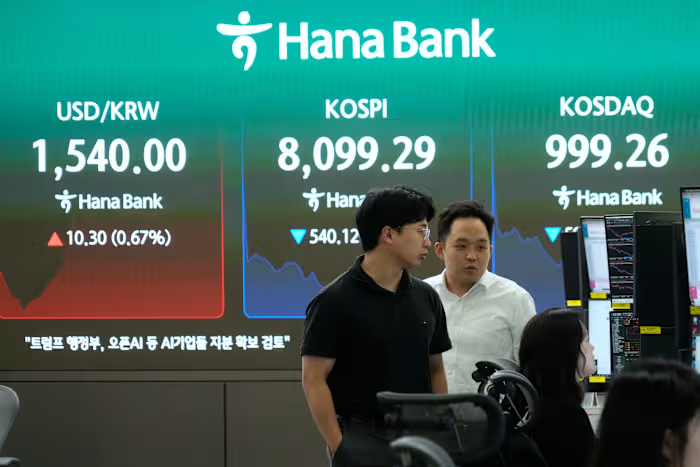
Shares across Asia took a significant hit, led by South Korea, where the benchmark index plummeted more than 5% as concerns over artificial intelligence-related stocks spread following sharp declines in the U.S. market. Futures for U.S. stocks also dipped, reflecting investor sentiment after Wall Street experienced mixed results on Thursday.
Notably, shares of Broadcom, a prominent computer chipmaker, fell by 12.6% after the company issued a forecast that failed to meet investor expectations. This news sparked worries about broader implications for the AI and technology sector, further compounding anxiety in the market. Other U.S. tech stocks also suffered, with memory chip manufacturer Micron Technology declining by 7.7%, and cybersecurity firm CrowdStrike Holdings down 3.8%. Despite this, the benchmark S&P 500 managed to rise by 0.4%, and the Dow Jones Industrial Average achieved a record gain of 1.7%. In contrast, the tech-heavy Nasdaq composite experienced a slight setback, closing down 0.1%.
In Asia, the fallout was particularly pronounced among key AI-related shares. South Korea’s SK Hynix plunged 8.4% while Samsung Electronics lost 5.4%. The Kospi index fell by 5.1% by midday, hitting 8,185.62, but it still shows considerable growth, having roughly doubled in value over the past year, driven by strong performance from major tech firms. Japan’s Nikkei 225 index decreased by 1.4% to 66,532.35, led by losses in technology stocks, despite reports that the nation’s real wages rose for the fourth consecutive month. Tokyo Electron, a chip equipment manufacturer, saw its shares fall by 7.2%.
Hong Kong’s Hang Seng index dipped 0.8% to 25,047.83, while the Shanghai Composite managed a modest gain of 0.4%, reaching 4,075.31. Australia’s S&P/ASX 200 fell 0.5% to 8,639.50, and Taiwan’s Taiex dropped 1.5%. However, India’s Sensex posted a slight uptick of 0.2%.
In the crude oil market, prices showed signs of stabilization after a drop the previous day. Brent crude, which serves as the international benchmark, rose by 0.4% to $95.42 per barrel after having fallen to around $95.03. Benchmark U.S. crude edged up by 0.1% to $93.15 per barrel. Despite recent pressures, driven in part by geopolitical tensions surrounding the Strait of Hormuz, oil prices reflect a complex landscape. The region remains critical for global oil and natural gas transport, and ongoing conflicts threaten both economic growth and inflation worldwide.
Conversations between American and Iranian negotiators indicated the possibility of extending a ceasefire last week; however, the detail of such an agreement is yet to be finalized. The situation is further complicated by developments involving Hezbollah, which recently rejected a ceasefire proposal related to the ongoing conflict between Lebanese and Israeli governments.
Market analysts at ING pointed out that while expectations of a U.S.-Iran deal to resume oil flows through the Strait of Hormuz persist, these hopes may be overly optimistic, especially in light of the latest geopolitical developments.
In foreign exchange markets, the U.S. dollar weakened slightly against the Japanese yen, trading at 159.97, down from 160.03 yen. The euro also saw a minor increase, trading at $1.1614 compared to $1.1610 earlier.