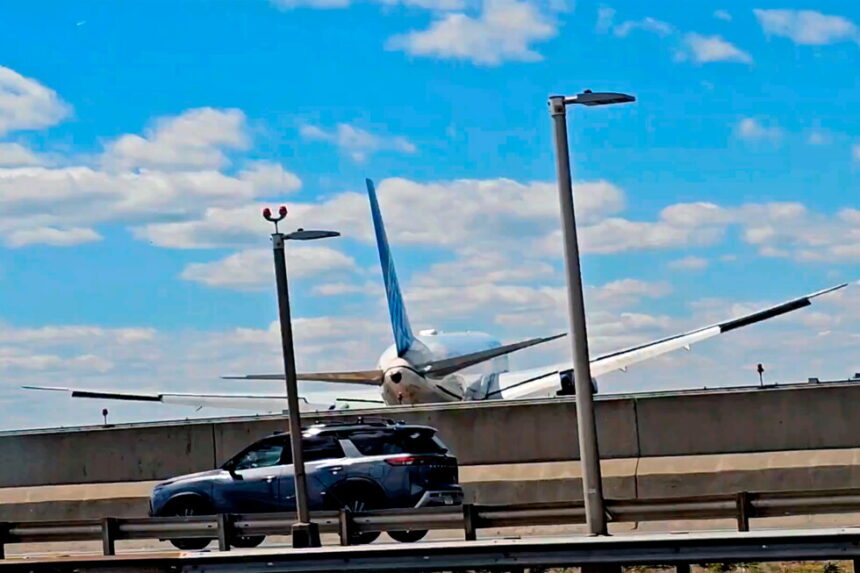
The copilot of a United Airlines flight that struck a light pole during its landing at Newark Liberty International Airport last month recognized the plane’s descent was too low. However, he did not communicate this realization in time to call for an aborted landing, according to a preliminary report released by the National Transportation Safety Board (NTSB). The incident occurred on May 3 during a flight originating from Venice, Italy.
As the aircraft descended, crew members reported experiencing a loud “thump” and a “mild jolt” immediately before touchdown. The first officer noted his observation of the plane being “still slow and a little low” as it approached the runway. He mentioned looking outside and believing the aircraft was about to land, but he was unable to voice a warning until it was too late.
The report is the first to provide insight into the crew’s perspective during the event. However, it does not specify the reasons for the low approach nor does it offer recommendations for preventing future incidents. The NTSB is expected to release a comprehensive final report next year.
In a significant clarification, the report states that it was debris from the light pole that struck a truck traveling on the New Jersey Turnpike, rather than the airplane itself, which law enforcement had initially indicated. Minor injuries were reported for the truck’s driver, whose vehicle sustained damage to its windshield and trailer, but there were no tire marks indicating a direct collision with the plane.
The Boeing 767 ultimately landed safely despite sustaining “substantial” damage to its fuselage, including slash marks on one of its landing tires. Fortunately, none of the over 200 passengers and crew members aboard were injured.
Drivers on the stretch of Interstate 95 near Newark are accustomed to seeing low-flying planes as they approach the airport. Dashcam footage from the truck captured the moment of impact. The video shows the driver singing cheerfully, only to react with concern when the sound of the approaching jet becomes noticeable. Just before impact, part of the aircraft appears in view from the driver’s window.
The NTSB report indicates the pilot may have intentionally adopted a shallow approach rather than adhering to the established flight path. D. Blake Stringer, director of the Center for Aviation Studies at Ohio State University, noted that the approach was likely not the recommended practice, as pilots are generally advised to steepen their descent when unable to maintain the intended trajectory.
Retired United Airlines captain and safety expert Steve Arroyo observed that the pilots should have better prepared for the specific requirements of their assigned runway, especially given they could have requested additional time if needed. The runway assignment changed three times prior to landing, with the pilots ending up on the shortest runway, typically used only during strong winds—conditions that were present at the time.
Aviation safety expert Jeff Guzzetti pointed out that the strong winds, which gusted up to 31 mph, posed additional challenges for the pilots. The report reveals that shortly before landing, the pilot confessed to feeling that he “got fast” as he maneuvered into the headwind, which required him to reduce power in response to moderate turbulence.
United Airlines has chosen not to comment further on the incident.