US stock futures experienced a notable decline on Friday, pulling back from record highs amid persistent inflation concerns while market participants assessed the outcomes of the recent Trump-Xi summit in China.
Contracts for the Nasdaq 100 plunged 1.3%, with S&P 500 futures dropping by 0.9%, after achieving all-time closing highs on Thursday. Dow Jones Industrial Average futures also dipped about 0.6%, although broader losses eased slightly in premarket trading.
President Trump wrapped up his two-day visit to Beijing, where he engaged in discussions with Chinese President Xi Jinping, focusing on fostering a business-friendly environment. The summit included 16 high-profile US executives and culminated in new deals for companies such as Boeing and Nvidia. However, underlying diplomatic tensions related to Taiwan and Iran persisted.
During the summit, there were hopes that China might help the US navigate its ongoing conflict with Iran by leveraging its influence over its major oil supplier. Trump claimed that both countries “feel very similar about Iran,” but Xi adopted a more cautious stance, indicating that meaningful progress towards reconciliation remains elusive.
This lack of advancement has heightened inflation worries, as reflected in recent US economic data. Oil futures surged over 2%, with Brent crude surpassing $108 a barrel. Concurrently, benchmark 10-year Treasury yields rose above 4.5%, signaling a global bond market rout.
On the corporate front, shares of Figma surged as investors celebrated a strong late Thursday earnings report that indicated robust demand amid the artificial intelligence boom. Mizuho Financial, RBC Bearings, and Sigma Lithium were also set to announce their financial results on Friday.
In another development, billionaire investor Bill Ackman revealed that his hedge fund has acquired a stake in Microsoft. He emphasized that Microsoft’s valuation did not fully reflect the potential value of its substantial stake in OpenAI, estimated to be around $200 billion.
Meanwhile, the global bond market faced pressure as concerns over economic repercussions from the Iran war mounted. Traders anticipated faster-than-expected interest rate hikes by the Federal Reserve in response to inflation driven by energy shocks. US Treasury yields reached their highest levels in about a year, while European bonds also came under selling pressure.
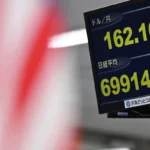
Asian markets exhibited declines as optimism from the Trump-Xi meeting dissipated, with fears about inflation dominating investor sentiment. The MSCI index for Asia-Pacific shares outside Japan dropped 2.3%, marking a weekly loss of 1.8%. Japan’s Nikkei decreased by 1.8%, influenced by a report revealing a 4.9% rise in wholesale inflation, the fastest rate in three years.
On the energy front, oil prices remained on track for a weekly gain, attributed in part to the ongoing turmoil in the Strait of Hormuz. Brent crude advanced toward $107 a barrel, amid a backdrop of significant supply disruptions stemming from geopolitical tensions.
As markets grappled with a whirlwind of economic indicators and corporate earnings reports, investor sentiment remained cautious, weighing the potential implications on growth and monetary policy in the midst of a turbulent global landscape.