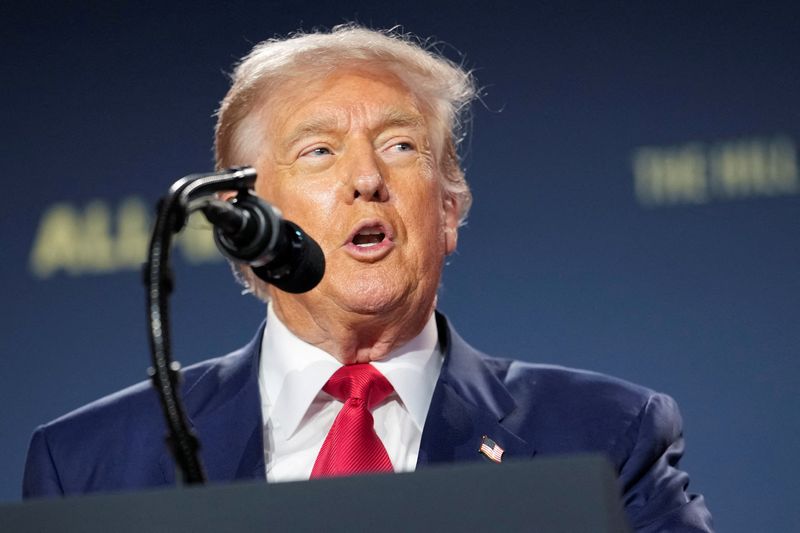
U.S. President Donald Trump recently indicated that his administration is exploring the possibility of allowing artificial intelligence (AI) companies to give the American public a stake in their operations. During a press conference aboard Air Force One, he remarked on the intriguing nature of such an arrangement, suggesting it could foster a form of partnership between AI firms and the citizens of the United States. Trump announced plans to convene a meeting with executives from leading AI companies as early as next week to discuss this idea further.
Reports from digital news outlet NOTUS revealed that senior officials within the U.S. government have already engaged in preliminary talks with major AI companies regarding the prospect of the government acquiring shares in their businesses. However, the White House has not provided specific details about the upcoming meeting, including whether the discussion will extend to the government’s potential stake in these firms. Press inquiries sent to major players in the AI sector, including Anthropic, OpenAI, Google, Facebook, and SpaceX, went unanswered.
The Trump administration faces increasing pressure to determine the appropriate level of regulation for AI technology. A previously planned signing ceremony for an executive order on AI was unexpectedly canceled. Reports suggest that the tech industry pushed back against certain provisions of that directive, prompting Trump to reconsider and ultimately express dissatisfaction with components that could potentially hinder U.S. competitiveness against China in the AI arena.
Recently, Trump signed a revised version of the executive order that invites top AI developers to voluntarily submit their most advanced models for government cybersecurity evaluations prior to their public release. This move is part of a broader response to escalating concerns regarding AI advancements, notably following the introduction of Anthropic’s powerful tool, Mythos. Experts warn that, if misused, Mythos could significantly expedite sophisticated cyberattacks, targeting critical sectors like banking that depend on complex and often outdated technology infrastructures.
Moreover, the administration has taken an unprecedented approach to its involvement in the U.S. corporate landscape, having already acquired stakes in prominent companies, including the semiconductor manufacturer Intel, along with a select number of rare earth and quantum technology firms.