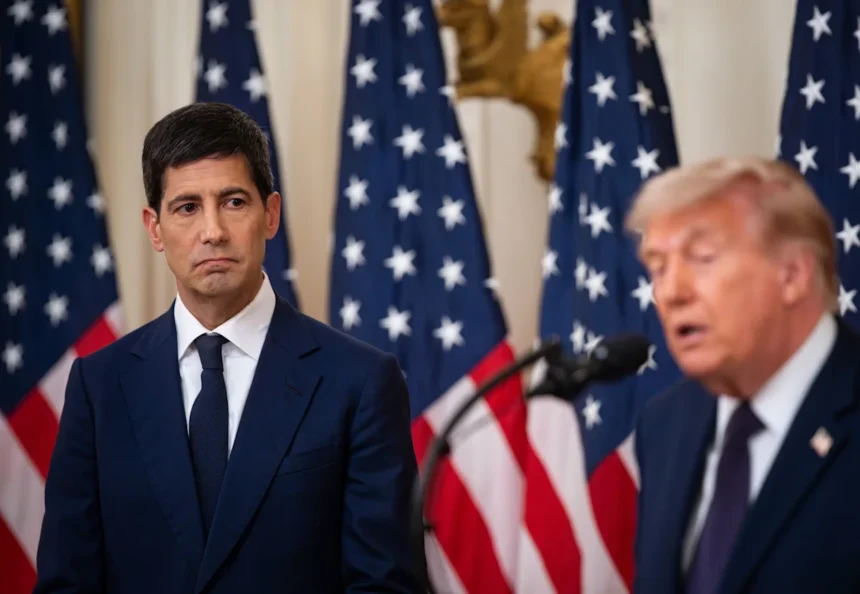
President Donald Trump has expressed strong opposition to the Federal Reserve raising interest rates, particularly as his nominee Kevin Warsh is set to chair his first policy meeting. In an interview with NBC’s Meet the Press, Trump aimed to counter recent market reactions following a robust U.S. jobs report for May, which has led investors to anticipate a potential rate hike aimed at curbing inflation.
“The market has been reacting negatively to positive reports, worrying they’ll raise interest rates,” Trump stated. He emphasized that there is “no reason to raise interest rates,” reflecting his broader economic philosophy that suggests lower rates foster growth rather than hinder it.
In his comments, recorded on Friday but aired on Sunday, Trump highlighted the challenges Warsh will face as he prepares for the Federal Open Market Committee meeting scheduled for June 16–17. He characterized any increase in the benchmark rate as misaligned with current economic conditions, asserting that the Fed should consider lowering rates instead.
The recent employment report revealed that job growth in May exceeded expectations, which triggered a selloff in Treasury bonds and led traders to estimate a quarter-point increase in the Fed’s key rate by the end of the year. The data indicated that nonfarm payrolls rose by 172,000, with prior months being revised upwards. The unemployment rate remained steady at 4.3%, further fueling speculation about the Fed’s next moves.
Trump, while supportive of Warsh, hinted at his dissatisfaction with the potential shift in monetary policy. “I’m living with Kevin,” he remarked, recognizing Warsh’s qualifications but asserting that an immediate rate hike would unfairly penalize a thriving economy. Additionally, he touched on the broader implications of interest rates on national priorities, such as military funding and managing national debt.
Market sentiments have been shifting, with growing confidence that under Warsh’s leadership, the Fed may feel compelled to raise borrowing costs to address inflation, which is running above the targeted levels. Following the strong labor market indicators, economists at Goldman Sachs revised their expectations, eliminating forecasts for a rate cut in December 2026 and adjusting their predictions for rate reductions to 2027.
Overall, Trump’s commentary underscores the complex interplay between political advocacy for lower interest rates and the economic indicators that suggest a tightening monetary policy may be necessary to mitigate inflationary pressures. As Warsh steps into his new role, these dynamics are set to significantly influence upcoming discussions within the Federal Reserve.