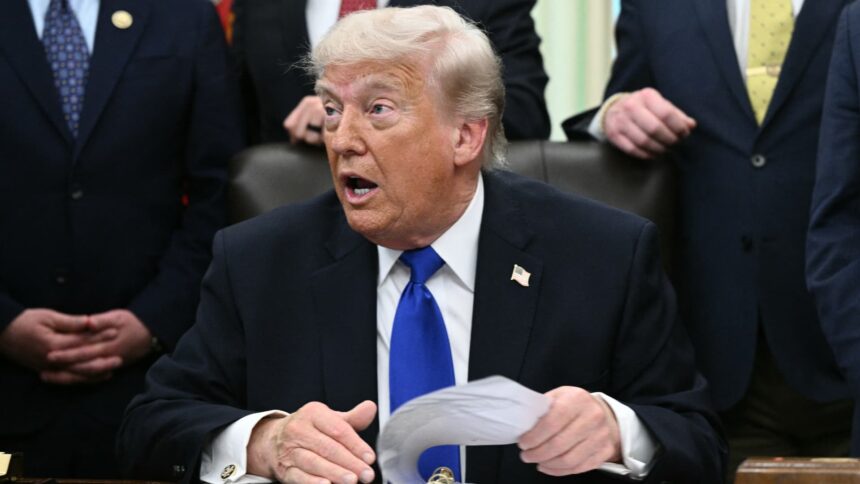
In a significant move aimed at strengthening the financial futures of millions of Americans, President Donald Trump has signed an executive order to establish a new retirement savings initiative. This program focuses on the approximately 56 million workers who currently do not have access to employer-sponsored retirement plans, such as 401(k)s.
Trump’s executive order outlines plans to launch a new website, TrumpIRA.gov, set to go live next year. This resource will empower individuals to research, compare, and enroll in private-sector individual retirement accounts (IRAs). Eligible participants may also qualify for matching contributions from the federal government. During a White House press conference, Trump pointed out, “You’ll then be able to access the same type of retirement accounts that federal employees enjoy through the Thrift Savings Plans.”
The program is designed to assist low-income Americans by offering up to $1,000 per year in matched funds directly deposited into their retirement accounts. This initiative builds upon the Saver’s Match program, which resulted from 2022’s Secure 2.0 legislation, providing a matching contribution of 50% for lower-income earners, capped at $1,000 annually for contributions to qualified retirement accounts.
As Trump aims to broaden the program’s scope, he and his administration are seeking legislative backing to enhance this initiative further. Recent proposals could set the groundwork for a new framework in Congress that might include auto-enrollment and increased match values, as highlighted by an investment research firm’s study revealing the potential for a 77% increase in cumulative American retirement wealth—up to $1.35 trillion—over the next decade.
Current White House figures indicate that about 40.6 million full-time workers do not participate in any retirement plan, while approximately 48.8 million are without employer-matching contributions. The executive order intends to address this gap, targeting those without access to retirement savings opportunities.
Starting in tax year 2027, these new accounts will potentially benefit single taxpayers making up to $20,500 and joint filers earning up to $41,000, who will qualify for a 50% government match on contributions up to $2,000. The proposal strategically aims to capture lower- and moderate-income workers by adjusting the matching contributions based on income levels.
Kevin Hassett, Director of the National Economic Council, has expressed optimism about attaining legislative support to broaden the program’s reach, highlighting potential collaborations with existing bills like the Retirement Savings for Americans Act and the Automatic IRA Act, which have been presented in Congress.
The Retirement Savings for Americans Act seeks to automatically enroll full- and part-time workers without employer-sponsored plans at a rate of 3% of their income, with low- to moderate-income workers receiving a possible 4% match from the federal government. Conversely, the Automatic IRA Act aims to require employers with more than ten employees to enroll workers in IRAs with initial contributions set to increase gradually.
Morningstar’s research into the potential effectiveness of these proposals found that automatic enrollment could draw in 32.3 million new savers, equating to a 28% overall increase in retirement wealth. The study emphasized that automatic systems are vital for increasing participation rates, contrasting with voluntary structures, which are likely to yield minimal engagement.
Researchers have explored various enhancements to the proposed plan, including increasing the Saver’s Match and raising income thresholds for contributions. Such improvements have the potential to significantly elevate savings for Americans, especially those with lower incomes.
Morningstar’s findings highlight the crucial importance of steady saving behavior over time, suggesting that consistent contributions, particularly in auto-enrollment scenarios, could lead to significantly higher retirement wealth for long-term savers. Consistently adding to retirement portfolios is underscored as the primary determinant of an individual’s financial security in retirement.
As discussions continue around legislative support and program enhancements, the administration remains focused on building an accessible retirement savings framework that could transform the financial landscape for millions of Americans currently without adequate retirement savings options.