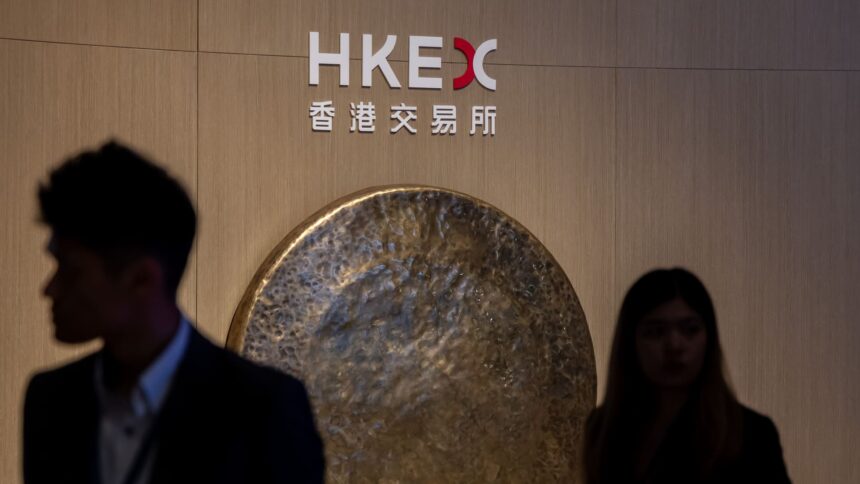
During the recent listing ceremony for Contemporary Amperex Technology Co. Ltd. (CATL) held at the Hong Kong Stock Exchange, concerns over the performance of new initial public offerings (IPOs) in the region came to light. Despite Hong Kong’s position as the leading global market for IPO funds raised last year, surpassing both the New York Stock Exchange and Nasdaq, the trend of underwhelming stock performance among newly listed companies is increasingly alarming.
As of now, over 600 firms are poised to debut on the Hong Kong exchange, indicating robust activity in the marketplace. However, data from Wind Information reveals a troubling statistic: out of 179 IPOs since January 2025, nearly half have experienced declines in their stock prices over the past three months. In contrast, the benchmark Hang Seng index has seen only a mild dip, while the FTSE Renaissance Global IPO Index has registered gains exceeding 10% during the same timeframe.
The performance for companies partaking in the Stock Connect program— facilitating direct investment from mainland China—paints an even bleaker picture. Of the 33 newly listed Hong Kong stocks that entered the program on March 9, more than half saw their prices more than double from IPO to just before their inclusion. Yet, since then, all eight of the companies that surged by over 300% have faced price drops of 10% or more, with AI startup Deepexi witnessing a staggering 51% fall as of early June.
Beijing’s financial authorities are taking note of these fluctuations, with state-backed publications emphasizing the inconsistencies marked by sharp price rallies followed by significant declines in Hong Kong IPOs. Analysts indicate that many Hong Kong-listed H shares are already represented as A shares in mainland China, which has led to capital flows shifting back to A shares once they become part of the Connect program. Investment strategists have observed that certain funds in Hong Kong have capitalized on this inclusion as a strategy for generating returns.
Goldman Sachs has projected that companies may raise around $60 billion through Hong Kong listings this year, almost doubling the $36 billion gathered in 2025. However, the investment firm’s recent downgrade of Hong Kong H shares in favor of A shares signals a shift toward what they believe will offer greater opportunities, particularly in artificial intelligence hardware.
Market experts highlight that various factors influence stock price performance in Hong Kong. There is a growing sentiment that low fees, softer fundraising conditions, and mounting competition are exerting pressure on segments of China’s financial landscape, subsequently placing a focus on short-term results.
As the market prepares for upcoming tests with new entrants like Knowledge Atlas Technology, responsible for the AI model Zhipu, and AI firm MiniMax—both of which listed in Hong Kong earlier this year—the industry remains vigilant in navigating this challenging environment.