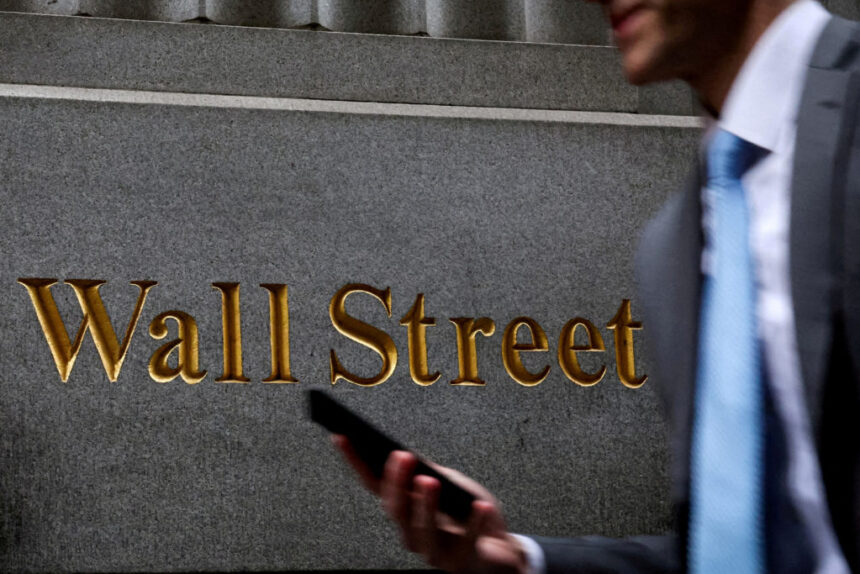
Stocks on Wall Street showed signs of recovery on Monday, rebounding from a significant sell-off experienced the previous week, particularly benefiting from the artificial intelligence (AI) boom. The S&P 500 rose by 0.3%, recovering from a substantial 2.6% drop recorded on Friday, which marked its deepest slump since October. The Dow Jones Industrial Average, however, saw a slight decrease of 80 points, or 0.2%, while the tech-heavy Nasdaq composite gained 0.9%.
Tech companies, especially those involved in chip manufacturing, led this recovery. These firms had faced a sharp decline last week amid concerns that their stock prices had surged excessively due to a rush of enthusiasm surrounding AI advancements. The ramifications were felt internationally, with South Korea’s Kospi index plummeting 8.3% early Monday, heavily impacting major tech players like Samsung Electronics and SK Hynix.
As trading transitioned from Asia to Europe and finally to North America, a turnaround occurred. Micron Technology saw a substantial 9.9% increase, bouncing back from a 13.3% drop on Friday, which had marked its worst day since the AI hype began taking off. This latest uptick continues a remarkable trend for Micron’s stock, which has seen its value more than triple throughout 2026.
Similarly, Marvell Technology surged 9.6% following news that its stock had met the criteria to join the S&P 500 index. This rise is part of a year-long trajectory where Marvell’s stock has also more than tripled, spurred dramatically by a single-day increase of 32.5% last week after Nvidia’s CEO suggested that Marvell could become the “next trillion-dollar company.”
The euphoria surrounding AI stocks has drawn skepticism, with many critics warning of unsustainable growth rates. A prominent index tracking semiconductor stocks has surged nearly 85% so far this year. Market analysts are now questioning whether Friday’s downturn marked the beginning of a more significant decline or simply a brief moment meant to correct excessive optimism.
Michael Wilson, a strategist at Morgan Stanley, expressed a more optimistic view, suggesting that the recent correction was healthy for the continuation of the bull market. He projected a potential rise in the S&P 500 to his target of 8,000 points, representing an 8.3% increase from its Friday closing figures.
In a notable partnership, Corning Inc. saw its shares rise 5.6% after Amazon confirmed a multibillion-dollar deal for Corning to supply optical fiber and related products for its data centers nationwide. Conversely, Campbell’s stock dipped 0.9% despite reporting better-than-expected profit for the latest quarter, though revenue fell short of projections. Campbell’s stock is also set to exit the S&P 500 alongside the inclusion of Marvell Technology.
Summarizing the day’s trading, the S&P 500 gained 21.99 points, closing at 7,405.73. The Dow Jones Industrial Average fell 80.77 points to close at 50,786.01, and the Nasdaq composite increased by 220.23 points, finishing at 25,929.66.
In the oil market, prices initially surged following military confrontations between Israel and Iran, raising concerns of a broader conflict. Brent crude oil prices briefly exceeded $98 per barrel before receding as tensions appeared to ease, ultimately settling at $94.25 per barrel after a 1.2% increase from the previous Friday.
These rising oil prices have contributed to increasing inflation, impacting household expenses and putting upward pressure on bond yields. The bond market reflected this trend, with Treasury yields inching higher; the yield on the 10-year Treasury rose to 4.56% from 4.55%.
Internationally, stock markets were less favorable, with European indexes experiencing slight declines after sharp losses in Asian markets. Japan’s Nikkei 225 index fell by 3.8%, while stocks dropped 1.7% in Shanghai and 1.2% in Hong Kong.