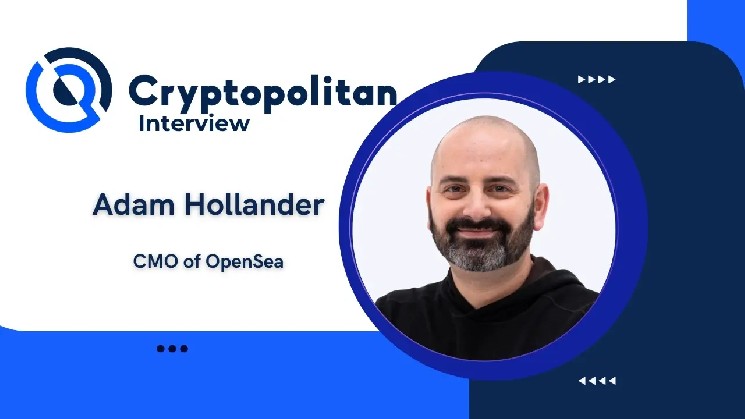
During the recent Consensus Miami event, Adam Hollander, the chief marketing officer of OpenSea, shared significant insights into the company’s evolution and future direction. In a discussion with Karnika E. Yashwant, known as Mr. KEY, the founder and CEO of KEY Difference Media, Hollander emphasized that OpenSea is striving to redefine itself beyond the $NFT boom, expanding its focus to encompass NFTs, meme coins, perpetual contracts, and major cryptocurrencies, all integrated into a single, non-custodial application.
Hollander’s journey to OpenSea began with the founding of a software company that was later acquired by Microsoft. Afterward, he took on the role of chief operating officer at a medical education company. His deepening interest in NFTs, fueled by years of collecting and trading, ultimately led him to OpenSea over a year ago.
While many still view OpenSea predominantly as the leading NFT marketplace, Hollander pointed out that the platform has undergone substantial changes. It now allows users to trade not only NFTs but also significant cryptocurrencies and meme coins across 26 different chains without needing to go through bridging processes. This new approach emphasizes non-custodial ownership, distinguishing OpenSea as a platform for those who wish to maintain control over their assets instead of confining them within closed applications.
Reflecting on the past, Hollander noted that many buyers during the NFT surge of 2021 and 2022 were not primarily motivated by the intrinsic value of artwork or community engagement, but rather by speculative investment—betting that future buyers would be willing to pay more. He underscored the vital aspect of digital ownership, which allows users to verify ownership, track the provenance of assets, and trace their history.
When asked about the rollout of OpenSea’s new features, Hollander revealed that the platform had been entirely rebuilt with a focus on enhancing user experience and simplifying asset trading. The new infrastructure, referred to as OS2, addresses limitations of the original platform, allowing for a more streamlined approach to discovering, trading, and owning digital assets.
Looking ahead, Hollander highlighted the upcoming OpenSea Mobile app as a key component of the company’s strategy to attract a broader consumer base. The app promises a user-friendly experience that enables wallet creation in seconds, allows for quick transactions using Apple Pay, and supports spending across multiple chains. The aim is to cater to both new users and experienced traders, providing straightforward access to purchasing desired assets.
In terms of user engagement, Hollander mentioned that over a million wallets have enrolled in OpenSea’s recent rewards program, with hundreds of thousands of unique users actively participating in trading across the platform. While he noted that many current users are crypto-savvy and possess non-custodial wallets, the new mobile application is designed to draw in individuals unfamiliar with the crypto ecosystem.
Currently, around 600 beta testers are evaluating OpenSea Mobile, providing crucial feedback that will help refine the app before its wider release. When asked about the discovery features of the platform compared to competitors like DeBank or CoinStats, Hollander claimed that OpenSea’s unique insight into cultural on-chain behaviors through NFTs gives it a competitive edge in asset recommendations.
Despite the inclusion of perpetual contracts in the app, Hollander clarified that OpenSea’s initial focus would not encompass decentralized finance (DeFi) functionalities. The primary goal remains direct asset ownership and easy access to trading, with potential future exploration of DeFi capabilities.
In addressing the competitive landscape, Hollander noted that many large custodial platforms fail to adequately support NFTs, positioning OpenSea as a champion of user-owned wallets and open access to digital assets.
Looking ahead to the next few years, Hollander expressed optimism about the app launch and plans for marketing to audiences outside the traditional crypto community. He’s confident that as OpenSea prepares for advanced trading features, such as agentic trading, it will further solidify its role in the evolving landscape of digital ownership and asset trading.