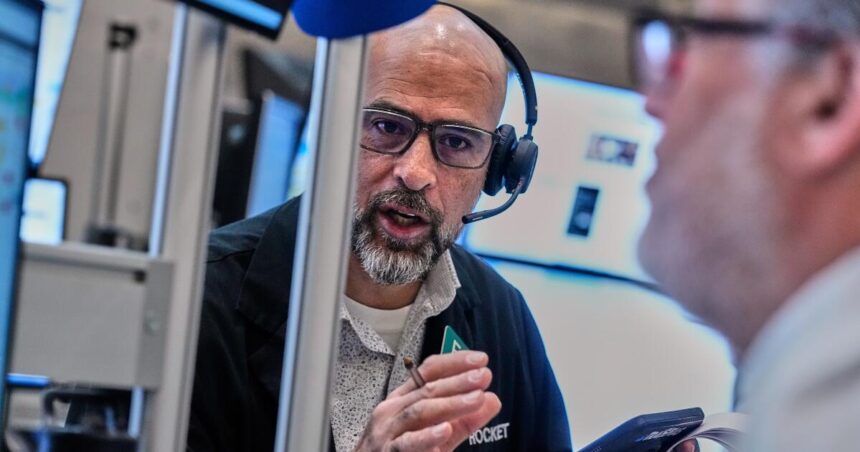
Another significant sell-off in artificial intelligence stocks contributed to a steep decline in U.S. markets on Wednesday, signaling continued volatility for these once high-flying shares. The S&P 500 fell by 1.6%, marking its first consecutive drop in three weeks and returning to levels not seen since early May. The Dow Jones Industrial Average suffered a loss of 953 points, or 1.9%, while the Nasdaq composite led the downturn with a 2% drop.
Market instability has become increasingly apparent since last week, when stocks in the AI sector shifted abruptly from record highs to steep declines. Analysts express concerns that the rapid climb in AI stock prices may have created an unsustainable bubble fueled by excessive enthusiasm. Investors are now left pondering whether this downturn represents a necessary correction or the onset of a more extended slump.
One notable casualty of the day’s trading was Super Micro Computer, which specializes in AI server technology. The company’s stock plummeted by 28% following its announcement to raise $7 billion through the sale of shares and convertible preferred stock. Such equity raises are typically more lucrative when stock prices are elevated, but they can also dilute existing shareholders’ interests.
Micron Technology, another tech player, experienced a rollercoaster day. After fluctuating between gains and losses, the stock closed down 4.7%. This follows a turbulent period where it dropped 7.7% last Thursday, another 13.3% Friday, and then rallied with a 9.9% gain on Monday. Despite these fluctuations, Micron’s stock is still up an impressive 212.5% year-to-date.
Leading the decline in the S&P 500 was Nvidia, a titan in the chip manufacturing industry that has surged to a valuation nearly reaching $4.9 trillion amid the AI boom. Nvidia’s shares fell 3.7%, while another AI success story, Broadcom, saw a 5.1% decrease in its stock price.
Investors are also looking to reposition their funds in anticipation of significant public offerings from various AI companies, including a much-anticipated IPO from SpaceX, which could happen later this week. This potential shift in investment has added pressure to the already declining AI stocks.
In addition to the AI sector’s troubles, stocks for companies with high operational fuel costs slid due to escalating oil prices, driven by ongoing conflicts in the Middle East. United Airlines reported a 6.2% decline, and cruise line operator Carnival’s shares dropped by 6.3% as oil prices rose following remarks from President Donald Trump regarding stalled negotiations with Iran. The price for Brent crude oil climbed 1.8% to $93.10, contributing to inflationary pressures.
Recent data revealed that U.S. consumer prices in May accelerated at their fastest rate in three years, leading to further concerns over inflation. However, amid this backdrop, Treasury yields remained relatively stable, as investors had anticipated these results. The yield on the 10-year Treasury note edged up to 4.54%, whereas the two-year Treasury yield held steady at 4.13%. Traders are increasingly betting that the Federal Reserve will need to raise its main interest rate at least once this year, considering high inflation and a robust job market.
The volatility in stocks often affects high-risk investments disproportionately, with critics suggesting that the surge in AI might be indicative of an asset bubble. Ultimately, the S&P 500 declined by 119.66 points to close at 7,266.99, the Dow dropped 953.33 points to finish at 49,918.78, and the Nasdaq composite fell by 509.32 points to end at 25,169.50.
On the international front, economic uncertainties resulted in mixed performances for European indexes, while Asian markets experienced sharper losses. South Korea’s Kospi fell by 4.5%, influenced by declines in tech giants Samsung Electronics and SK Hynix. Meanwhile, Japan’s Nikkei 225 dropped 1.9% in response to data indicating a surge in the country’s producer price index, which increased at the fastest pace in over three years. Shares of the AI-focused SoftBank Group also faced an 8.3% decline.