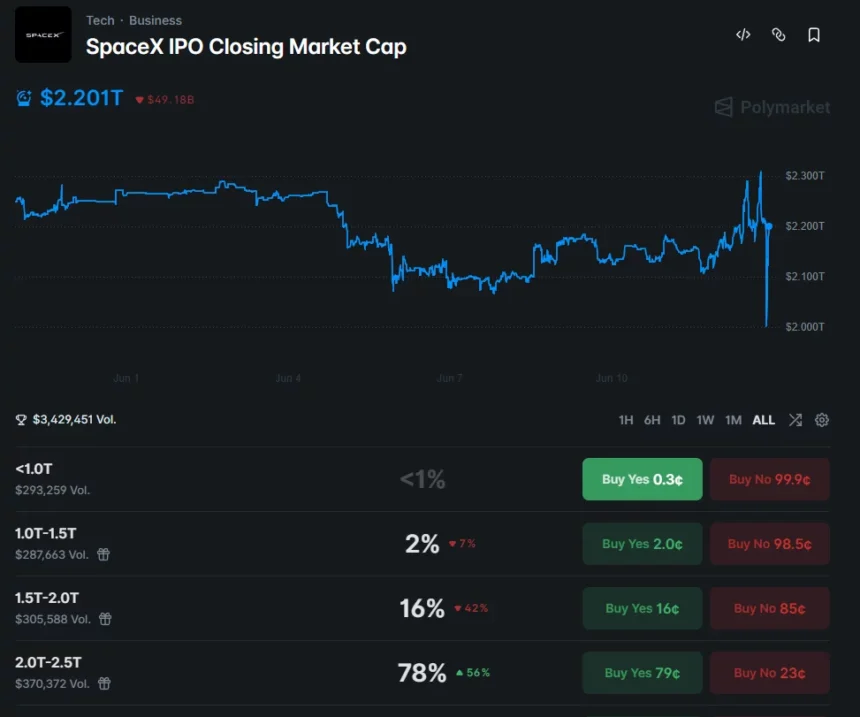
SpaceX’s recent debut on the Nasdaq has sent shockwaves through financial markets, seeing its valuation soar above $2 trillion after an impressive 37% surge in share price. The company’s initial public offering (IPO) priced at $135 per share, opened at $150, and peaked at $173.22 in early trading. This monumental IPO, raising about $75 billion, is now recorded as the largest in history, catapulting SpaceX among the United States’ most valuable companies, ahead of tech giants such as Meta, Tesla, and Broadcom.
The investor interest was staggering, with orders reportedly surpassing $350 billion even before trading commenced. This strong demand propelled SpaceX’s valuation to an impressive $2.12 trillion, placing it right among the highest-ranking companies in the country, including Nvidia, Alphabet, Apple, Microsoft, and Amazon.
As the IPO dominated headlines, it also initiated a significant wave of activity across cryptocurrency markets. Traders, eager to gain exposure to SpaceX without necessarily purchasing traditional shares, turned to tokenized stocks and synthetic assets. Companies like Backpack Securities and Sunrise introduced SPCX— a Solana-based token backed by SpaceX shares, which could be converted into actual stock for eligible users. Binance Wallet facilitated impressive subscription funds for its SpaceX-linked offerings, which initially priced tokens at 135 USDC.
Additionally, synthetic assets gained traction, with Hyperliquid’s SPCX perpetual contract garnering attention as one of the most actively traded products associated with the IPO. The rise in open interest for HYPE futures, reaching $2.56 billion, marked a shift, overtaking XRP in trading volume.
Velvet, another platform, saw its token surge by more than 1,400% within a week as it promoted synthetic SpaceX exposure. Prediction markets also fueled speculation, with a Polymarket contract forecasting strong odds for SpaceX’s market cap settling between $2 trillion and $2.5 trillion post-debut.
Despite analysts predicting that the largest IPO might siphon funds from digital assets, the cryptocurrency market remained resilient. Contrary to initial concerns, Bitcoin rose approximately 2%, Ethereum added 1.8%, and Solana gained 3.5%. Meanwhile, stablecoins like USDT and USDC held their ground at around $186.8 billion and $74.8 billion in market capitalization, respectively, maintaining their dollar pegs.
However, the valuation of SpaceX isn’t without controversy. Some analysts, like those from Morningstar, argue that the company’s fair value might be closer to $63 per share, far below the IPO price. Concerns voiced by Senator Elizabeth Warren regarding investor protection and market integrity have also raised eyebrows, questioning SpaceX’s valuation and governance.
Looking ahead, the larger implication from this IPO may not merely reside in SpaceX’s stock performance but in how it reshapes trading narratives around tokenized equities and synthetic shares. Options on SpaceX shares are set to trade next week, with keen interest from investors pondering future listings from emerging companies in the AI sector, such as OpenAI and Anthropic. Market observers are now left to wonder if this surge in tokenized stock activity will endure beyond the initial excitement surrounding SpaceX’s landmark IPO.