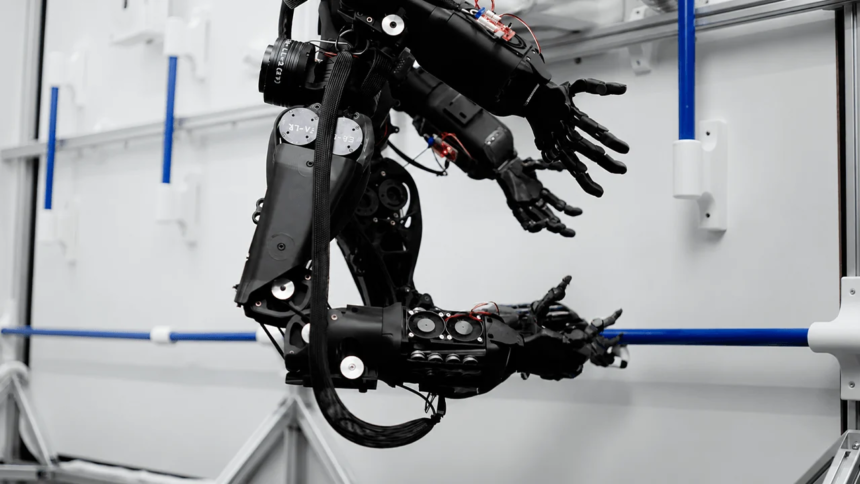
Orbit Robotics has officially introduced Helios, a cutting-edge four-armed humanoid robot designed specifically for station maintenance in the unique environment of microgravity. This announcement came with the release of a promotional video on May 20, 2026, highlighting Helios’s capabilities and purpose.
Helios is engineered to tackle the rigorous demands of operating in space, targeting tasks that traditionally cost around $140,000 per hour when performed by astronauts. By automating or enabling remote control for mundane maintenance and cargo handling duties, Helios aims to allow astronauts to redirect their attention to more critical scientific endeavors. The robot’s design reflects a pragmatic approach to orbital operations, focusing not on terrestrial capabilities but on functions that are essential in the vacuum of space.
This innovative humanoid stands out by forgoing legs entirely, opting instead for four articulated arms that offer 28 degrees of freedom. Helios is built to navigate the confines of space stations by moving hand over hand, anchoring itself onto structural elements such as rails and walls. This method not only adapts to the realities of microgravity but also maximizes the robot’s efficiency, allowing it to stabilize itself while utilizing two hands for various tasks.
Founded in late 2025 within the Swiss research ecosystem, Orbit Robotics aimed to create a solution specifically for the challenges space crews encounter. The design reflects a conscious choice to prioritize the needs of astronauts engaged in routine operations, such as inspections and cargo stowage. This focus aligns with industry trends as commercial space stations and servicing missions move closer to reality, particularly in light of post-International Space Station (ISS) planning efforts in the United States.
Helios’s design emphasizes functionality well-suited for microgravity. The absence of legs simplifies its operation, allowing it to move and work with two arms clamping down on surfaces while the other two manipulate tools or handle payloads. This robotic assistant can execute pre-programmed tasks autonomously, or it can be controlled remotely for more intricate operations, taking advantage of manageable latency in low Earth orbit. This feature minimizes disruption during delicate tasks, mirroring the movements of astronauts while eliminating the fatigue associated with prolonged manual work.
At a height of 5.2 feet and weighing 70 pounds, Helios utilizes a combination of aluminum alloy and carbon fiber in its construction, striking a balance between strength and lightweight agility. It boasts 14 degrees of freedom in its dexterous hands, allowing for precision handling, while electric actuators and tendon-based transmissions provide efficient mobility. With a runtime of three hours per charge and a maximum speed of 1.2 miles per hour, Helios is well-suited for navigating the interiors of space stations.
The economic implications of deploying such robotic technology in space cannot be understated, especially considering the high cost of astronaut time. With estimates placing the value of an hour of astronaut labor at approximately $140,000, utilizing Helios to manage repetitive tasks could significantly reduce operational expenses. As plans for commercial lunar infrastructure and new space stations mature, robots like Helios could play a transformative role in optimizing operations, turning routine checklists into automated background processes.
In summary, Helios not only embodies a technological leap for space maintenance but also represents a strategic evolution in how tasks will be executed in future orbital environments, positioning it as a practical co-worker designed for the unique challenges of space.