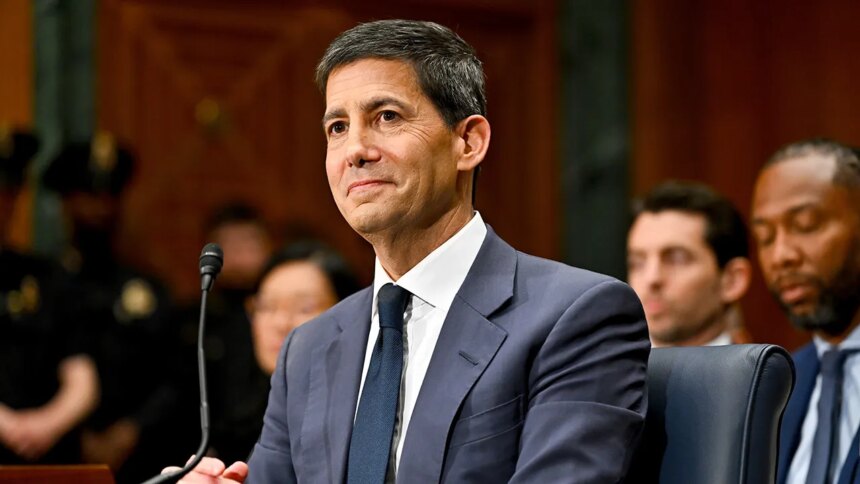
UBS managing director and senior portfolio manager Jason Katz recently appeared on Varney & Co. to share his insights on the current state of the markets, particularly the rotation and rally taking place, as well as expressing concerns over the Federal Reserve’s forthcoming decisions on interest rates.
This week, the Federal Reserve is anticipated to keep interest rates unchanged after its upcoming monetary policy meeting amidst rising inflation concerns. Newly appointed Chairman Kevin Warsh will also hold his first press conference post-meeting, where his remarks will be closely scrutinized for clues about the Fed’s outlook on economic conditions and future monetary policy actions.
The inflation rate has surged, notably influenced by the conflict in Iran which has triggered spikes in energy prices. The consumer price index (CPI) climbed to 4.2% in May, marking the highest level since April 2023, pushing inflation further away from the Fed’s target of 2%. This inflationary surge has led the market to anticipate no rate cuts during this week’s Federal Open Market Committee (FOMC) meeting, as those in the financial sector remain cautious.
According to the CME FedWatch tool, there is a 98.4% likelihood that the Fed will maintain its benchmark federal funds rate at the current target range of 3.5% to 3.75%. Interestingly, projections indicate a 42.7% chance that rates will remain unchanged at least until the December meeting, reflecting a shift in sentiment surrounding the prospects for interest rate adjustments.
Gregory Daco, chief economist at EY-Parthenon, noted the contrast between Warsh’s perceived dovish stance and the more hawkish sentiments of the current FOMC members. Several policymakers have indicated that rate hikes should stay on the table if inflation does not retreat to acceptable levels, a sentiment amplified by rising prices driven by energy concerns. Similarly, economists at JPMorgan, led by Michael Feroli, suggested that in light of the persistent inflation and robust labor market conditions, the FOMC should revise its post-meeting statement to eliminate any easing bias.
As the Fed prepares for Warsh’s first press conference, attention also turns to potential changes in its communication strategies and economic forecasts. Daco emphasized that the summary of economic projections (SEP), also known as the “dot plot,” is likely to receive heightened focus, especially since Warsh has previously questioned the relevance of such forecasts. There is speculation that he may choose not to submit his own projections, a move that, while largely symbolic, would underscore his belief in prioritizing real-time economic data over anticipated forecasts.
Goldman Sachs economists noted that while there may be discussions regarding the SEP going forward, significant alterations are not expected in the near future, given the FOMC’s recent comprehensive review of its communication practices.
As Warsh initiates his chairmanship, he faces questions about the anticipated “regime change” at the Fed, although analysts expect a lack of clarity regarding specific changes at this juncture. With several pressing issues on the horizon, including heightened inflation and the challenges facing American consumers, Warsh’s leadership will be pivotal in navigating these evolving economic conditions.